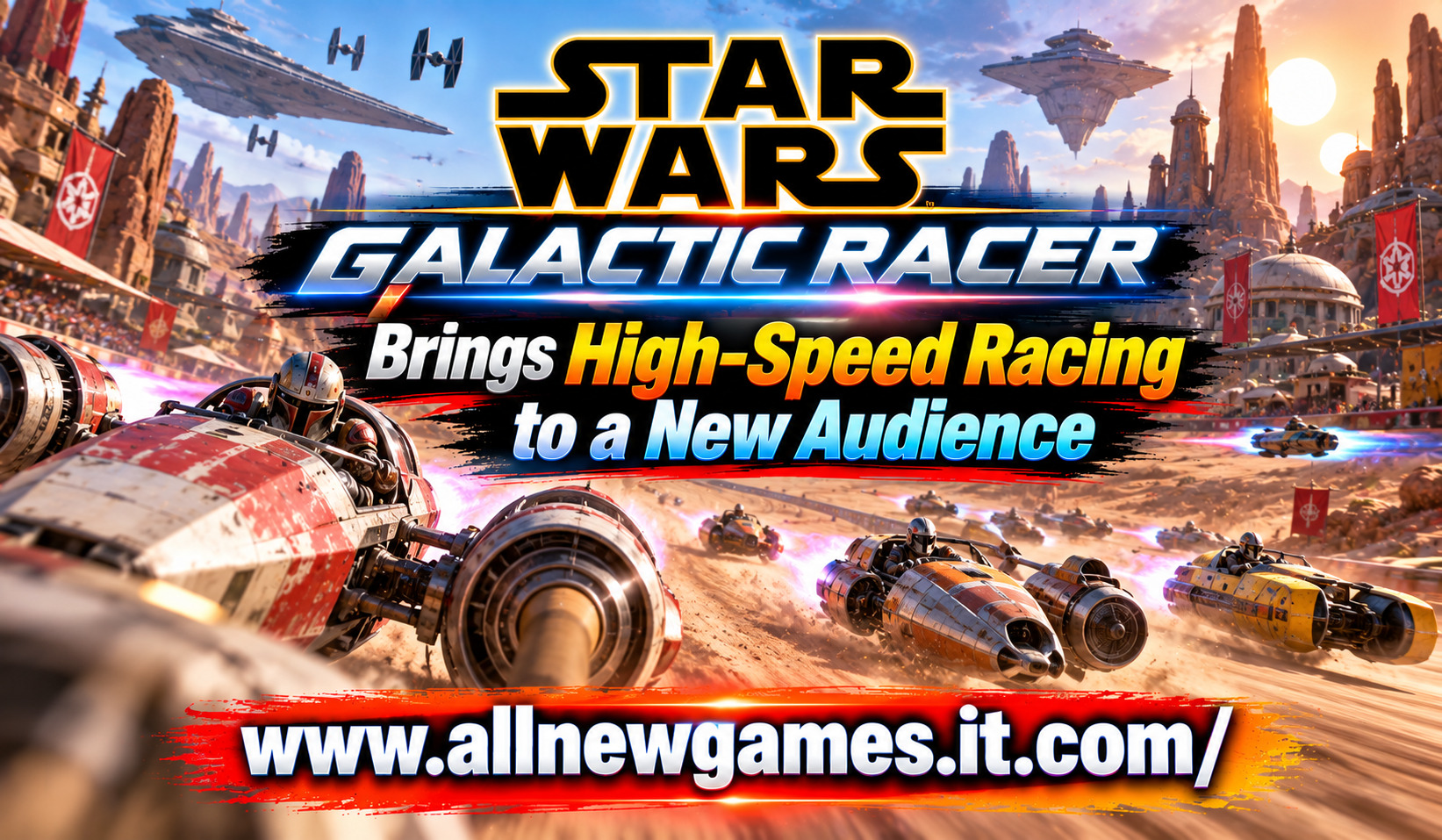
The Star Wars universe has always been known for its space battles, unforgettable characters, and futuristic vehicles. However, high-speed racing has also played an important role in the franchise, from the famous podrace in Star Wars: Episode I – The Phantom Menace to thrilling speeder chases across different planets. Now, Star Wars: Galactic Racer brings that racing tradition into a new gaming experience designed for longtime fans and a wider audience of racing enthusiasts.
Developed by Fuse Games and published by Secret Mode in collaboration with Lucasfilm Games, Star Wars: Galactic Racer launched on October 6, 2026. The game is available on PlayStation 5, Xbox Series X|S, and PC through Steam. It moves away from traditional lightsaber combat and large-scale space warfare to focus on speed, competition, vehicle handling, and high-risk races across the galaxy.
The central idea is straightforward: players enter an underground racing league where winning requires more than simply accelerating. Choosing the right vehicle, navigating dangerous tracks, upgrading equipment, and making quick decisions can determine whether a race ends in victory or a costly crash.
A New Racing Experience in the Star Wars Universe
Star Wars: Galactic Racer takes place during the early New Republic era, after the fall of the Galactic Empire. As the galaxy attempts to rebuild, an underground racing scene grows in the Outer Rim. The Galactic League becomes a place where racers compete for recognition, sponsors invest in talented pilots, and dangerous rivalries develop.
This setting gives the game a different identity from many other Star Wars titles. Instead of following a Jedi or a military pilot, players experience a world built around independent racers, ambitious competitors, and people willing to take serious risks for success.
The developers have designed the racing experience around skill, strategy, and survival. There is no need to rely on the Force or a chosen-one storyline to win. Players must learn how their vehicles respond, understand each circuit, and react quickly when opponents attempt to push them off course.
This approach could introduce the franchise to people who enjoy racing games but may not regularly play action-adventure or role-playing games. At the same time, familiar planets, vehicles, characters, and sound design provide Star Wars fans with a recognisable setting.
Multiple Vehicles Offer Different Ways to Race
One of the game’s biggest attractions is its selection of repulsorcraft. Rather than placing every competitor in an identical vehicle, Galactic Racer features several racing classes with different handling characteristics and tactical advantages.
Landspeeders offer a heavier racing style, while speeder bikes emphasise quick acceleration and tight cornering. Skim speeders provide another approach to navigating challenging tracks, and podracers bring the high-speed, multi-engine spectacle that many fans associate with Star Wars racing.
Each vehicle type encourages players to adjust their driving style. A machine that performs well on a wide straight section may feel difficult to control around narrow corners. Similarly, a vehicle that turns quickly may require more careful handling when travelling at extreme speeds.
Vehicle choice therefore becomes part of the strategy rather than a purely cosmetic decision. Players can experiment with different classes to find an approach that matches their strengths and the demands of each circuit, Players who enjoy vehicle-based action and high-speed gameplay may also like Ace Combat 8 Gameplay and Flight Features to Watch, which explores aircraft combat, flight mechanics, and immersive aerial battles.
Dangerous Tracks Make Every Race Unpredictable
The racing environments are another important part of the experience. The game features familiar Star Wars locations alongside new worlds, with different terrain and hazards influencing how players approach a race.
Jakku returns with its dusty landscapes and enormous wreckage from the Galactic Civil War. Other environments include the icy world of Ando Prime, the volcanic terrain of Sentinel One, and the lush landscapes of Lantaana. These settings give each race a distinct visual identity and introduce different challenges.
The circuits also feature branching routes, meaning players must pay attention to where they are going instead of following the same racing line throughout every event. Taking a route can involve balancing speed against danger, while aggressive opponents may turn a clean race into a fight for survival.
The most important environmental challenges include:
- Difficult terrain: Ice, sand, and other surfaces can demand different driving techniques.
- Track hazards: Obstacles and dangerous sections punish poor timing and careless steering.
- Branching routes: Alternative paths create opportunities to take risks and change racing strategy.
- Aggressive rivals: Opponents can disrupt a player’s run through contact and takedown attempts.
These elements help make racing feel less predictable. Players who memorise a circuit still need to react to opponents, vehicle behaviour, and the risks presented by the track.
A Campaign Built Around Rivalries and Risk
The single-player campaign follows Shade, an emerging racer with a personal grudge against the Bool family. Shade enters the Galactic League with the goal of challenging its powerful champion, Kestar Bool, whose influence extends beyond his achievements on the track.
The story also features Darius Pax, the organiser behind the league, Hibi, an energetic Ardennian mechanic, and the legendary podracer Sebulba. Together, these characters help connect the competition to a larger narrative involving ambition, rivalry, and control.
Rather than presenting a simple sequence of races, the campaign uses a runs-based structure. Players choose events, collect rewards, improve their vehicles, and decide how to progress through the league. Crashes and repeated mistakes can end a tour, forcing players to regroup and start again. Some perks and unlocks carry over, giving later attempts a sense of progression.
This structure introduces an additional layer of decision-making. Players must consider not only how to win the next race but also how to prepare for the events that follow. A risky approach may offer a valuable reward, but a serious mistake can cost progress.
For players who enjoy learning from failed attempts, this format could provide a reason to return to the campaign and experiment with different strategies.
Vehicle Upgrades and Customisation Add Depth
Winning races is only part of the experience. Players can earn or acquire vehicle parts and upgrades through Hibi’s workshop, allowing them to adjust their repulsorcraft to suit different challenges.
These improvements can provide stat boosts and abilities, giving players opportunities to develop specialised builds. Someone who prefers aggressive racing may focus on equipment that supports a confrontational style, while another player may prioritise handling, resilience, or speed.
Customisation also gives the game a progression system beyond simply unlocking the next event. As players learn which vehicle characteristics suit their driving style, they can make more informed decisions about how to spend their rewards.
The system is particularly relevant because the game’s tracks do not all demand the same skills. A setup that works well on a fast, open circuit may not be the best choice for a hazardous course filled with sharp turns and environmental dangers.
Multiplayer Brings Competition Beyond the Campaign
Online multiplayer gives players another reason to keep racing after completing story events. The game supports competitive races and cross-platform multiplayer, allowing players on supported systems to compete with one another.
For racing fans, online competition can offer a different challenge from the campaign. Computer-controlled rivals follow the game’s programmed behaviour, but human opponents can use unpredictable tactics, change their approach mid-race, and exploit mistakes in unexpected ways.
The game’s mix of vehicle classes, upgrades, and track hazards may also make multiplayer matches more varied. Success will depend on finding a balance between driving skill, vehicle setup, and awareness of the competition.
In addition to multiplayer, Galactic Racer offers Arcade and Scenario modes. These provide alternatives to the main campaign for players who want to practise, revisit racing challenges, or enjoy shorter sessions.
Key Features at a Glance
| Feature | What players can expect |
| Vehicle classes | Landspeeders, speeder bikes, skim speeders, and podracers |
| Different environments | Jakku, Ando Prime, Sentinel One, Lantaana, and other locations |
| Campaign | A rivalry-driven story featuring Shade and Kestar Bool |
| Runs-based progression | Event choices, rewards, upgrades, and the risk of losing a tour |
| Customisation | Vehicle parts, stat improvements, and specialised builds |
| Multiplayer | Competitive racing and cross-platform play |
| Additional modes | Arcade and Scenario options |
Why the Game Could Reach a Wider Audience
The biggest opportunity for Star Wars: Galactic Racer is its ability to appeal to two groups at once. Star Wars fans may be attracted by its locations, familiar racing traditions, and appearances from established characters. Racing enthusiasts may be more interested in the handling systems, track design, upgrades, and competitive challenge.
The game also offers a different kind of Star Wars adventure. Players do not need to be familiar with every film or television series to understand the central goal of racing, defeating rivals, and improving a vehicle. That makes the basic concept accessible to newcomers while leaving plenty of franchise references for existing fans to discover.
Its success will ultimately depend on how satisfying the vehicles feel, how varied the tracks remain, and whether the campaign offers enough meaningful choices to encourage repeated play. Visual spectacle can attract attention, but responsive controls and well-designed races are what keep players coming back.
Conclusion
Star Wars: Galactic Racer takes one of the franchise’s most recognisable activities and builds an entire game around it. Its varied vehicles, dangerous circuits, customisation systems, and rivalry-focused campaign offer a different way to explore the galaxy without relying on lightsaber battles or conventional space combat.
The runs-based campaign adds risk and replayability, while multiplayer gives players opportunities to test their skills against human opponents. For Star Wars fans, it offers a fresh perspective on the galaxy. For racing enthusiasts, it provides a science-fiction setting built around speed, tactical decisions, and high-stakes competition.
By bringing these elements together, Star Wars: Galactic Racer has the potential to introduce high-speed Star Wars racing to a broader audience.
Frequently Asked Questions
1. What is Star Wars: Galactic Racer?
It is a science-fiction racing game set in the Star Wars universe, focused on high-speed repulsorcraft competition, vehicle upgrades, and a story-driven campaign.
2. When was Star Wars: Galactic Racer released?
The game launched on October 6, 2026.
3. Which platforms support Star Wars: Galactic Racer?
It is available on PlayStation 5, Xbox Series X|S, and PC through Steam.
4. What vehicles can players race?
Players can pilot landspeeders, speeder bikes, skim speeders, and podracers, each offering a different racing style.
5. Does the game have multiplayer?
Yes. The game supports competitive online racing and cross-platform multiplayer.