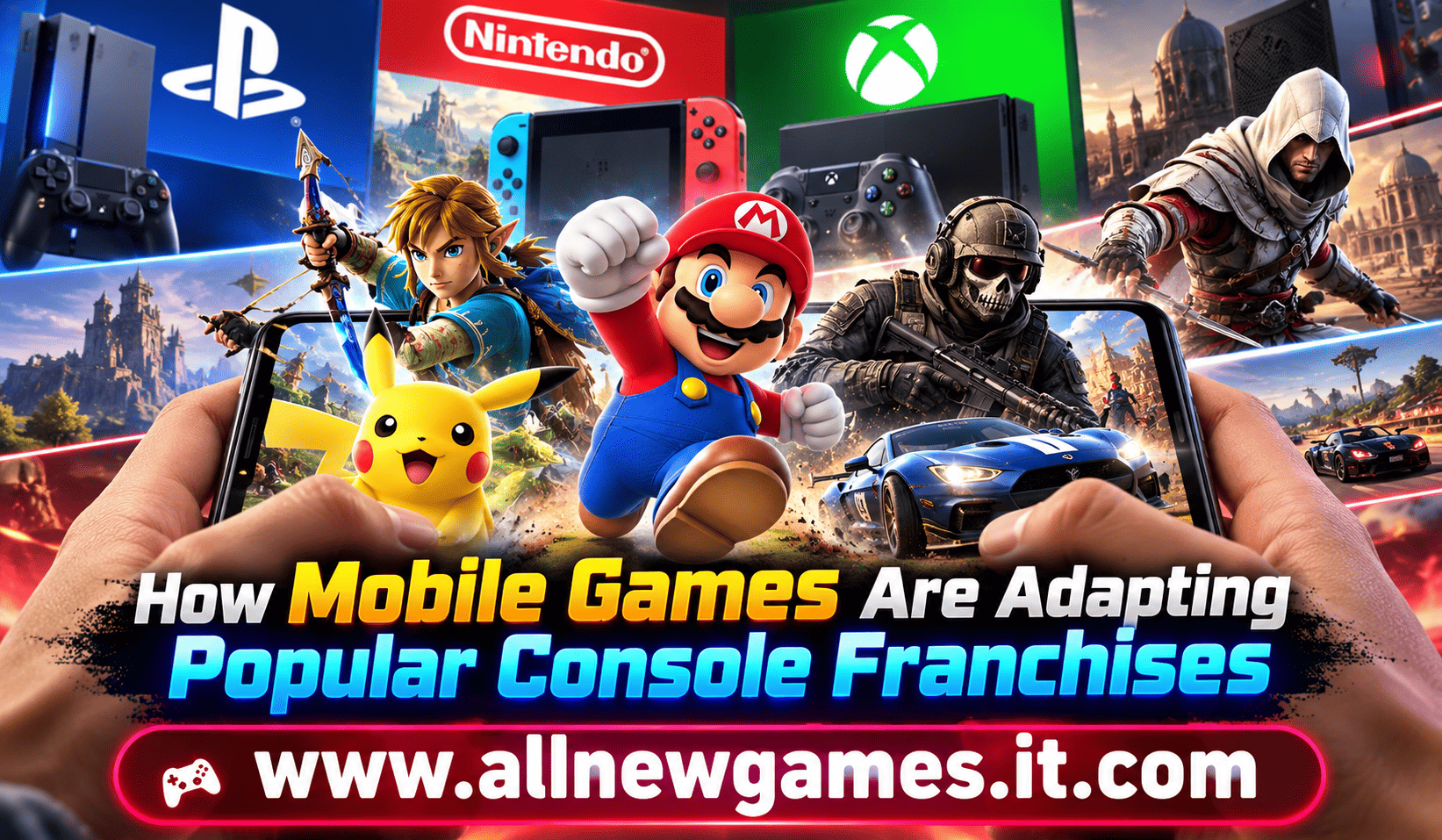
Mobile gaming has evolved from simple puzzle games and casual experiences into a major platform for action, adventure, role-playing, and competitive multiplayer titles. As smartphones become more powerful, developers are finding new ways to bring familiar console franchises to mobile audiences. Instead of limiting these properties to PlayStation, Xbox, Nintendo, or PC, publishers are exploring mobile adaptations that introduce popular characters, worlds, and gameplay systems to a wider group of players.
This shift is changing how gaming franchises reach their audiences. Well-known series can now offer new adventures on smartphones, while players who do not own expensive gaming hardware can experience parts of their favourite universes. Games such as Call of Duty: Mobile and The Division Resurgence demonstrate how established franchises can be adapted for portable play without abandoning their central identity.
However, bringing a console franchise to mobile is not as simple as shrinking a game onto a smaller screen. Developers must reconsider controls, graphics, mission design, performance, monetisation, and session length. Some adaptations recreate the original experience, while others introduce entirely new gameplay styles inspired by the same fictional universe.
Why Gaming Companies Are Expanding Console Franchises to Mobile
One of the biggest reasons behind this trend is accessibility. Smartphones are widely used for communication, entertainment, and gaming, making them a convenient platform for reaching players who may not own a console. A mobile adaptation can introduce an established franchise to people who have never played its original releases.
Mobile games also offer opportunities to keep a franchise active between major console launches. Instead of waiting several years for another mainline instalment, fans may receive a separate mobile experience featuring familiar settings, characters, weapons, or stories. Publishers can use these releases to maintain community interest while exploring new audiences.
Another advantage is the flexibility of mobile gaming. Players can complete a short mission during a break, participate in multiplayer matches while travelling, or return to a larger progression system whenever they have time. This convenience creates opportunities for franchises traditionally associated with long gaming sessions.
Nevertheless, the strategy requires careful planning. A recognisable brand may attract initial attention, but long-term success depends on whether the mobile game is enjoyable, technically stable, and suited to the expectations of smartphone users.
1. Rebuilding Gameplay for Touchscreen Controls
Controls are among the most important elements developers must reconsider when adapting console games. Traditional controllers provide physical buttons, analogue sticks, and triggers. Smartphones instead rely primarily on touchscreens, where players interact directly with virtual buttons and on-screen movement controls.
For shooting games, this presents a particular challenge. Players may need to aim, move, reload, switch weapons, and activate abilities simultaneously. If the interface becomes crowded, combat can feel uncomfortable even when the underlying game mechanics are strong.
Developers are addressing this problem through adjustable layouts, automatic assistance, simplified interactions, and customisable sensitivity settings. These features help players find a comfortable control arrangement for different screen sizes and playstyles.
Call of Duty: Mobile provides a useful example. The game brings familiar multiplayer shooting, customisable loadouts, recognisable maps, and battle royale gameplay to smartphones. Activision’s original development approach emphasised adapting movement, aiming, and controls to deliver a playable first-person shooter on mobile devices. The result demonstrates how a franchise can preserve its identity while modifying its interface for a different platform.
The key lesson is that touchscreen controls should be designed around mobile play rather than treated as a secondary version of a console interface.
2. Preserving Familiar Worlds While Introducing New Experiences
A successful adaptation needs to balance familiarity with innovation. Players often download mobile games because they recognise a franchise, but they also expect the new title to offer something worth exploring.
Some developers recreate familiar environments, characters, and gameplay systems. Others use the original universe as a foundation for a different genre. Both approaches can work when the adaptation respects the qualities that make the franchise distinctive.
For example, The Division Resurgence brings Ubisoft’s third-person role-playing shooter series to mobile devices. Its experience includes an urban open world, story missions, equipment progression, specialised abilities, cooperative gameplay, and competitive activities. Ubisoft launched the game on iOS and Android on March 31, 2026, expanding the franchise beyond its traditional platforms.
The mobile version retains the series’ emphasis on tactical combat and equipment development while accommodating touchscreen controls and portable play.
A different approach can be seen in Overwatch Rush, announced by Blizzard in April 2026. Rather than directly porting the main Overwatch experience, the project introduces a top-down hero shooter built specifically for mobile. Blizzard described it as a separate game designed around mobile play, with testing and further development planned through its development process.
These examples illustrate two different adaptation strategies: translating established gameplay systems to mobile and creating a new gameplay format within an existing franchise.
3. Shorter Sessions Without Losing Progression
Console adventures often encourage players to spend extended periods exploring environments, completing quests, or participating in multiplayer activities. Mobile games must also accommodate people who prefer shorter sessions.
Developers can achieve this through clearly defined missions, quicker matchmaking, shorter matches, and progression systems that reward players for completing manageable objectives. The challenge is to make these activities feel meaningful rather than repetitive.
Role-playing games provide a useful example of this approach. Character upgrades, equipment rewards, unlockable abilities, and mission objectives can create a sense of progress even when players have limited time available.
Mobile adaptations may also include daily objectives and recurring events. These systems provide additional activities between major story missions, although they need careful balancing to avoid making the game feel like a list of compulsory tasks.
The most effective approach combines convenient sessions with deeper progression. Players should be able to make meaningful progress during a short visit while still having larger goals to pursue when they have more time.
4. Improving Graphics While Managing Device Limitations
Modern smartphones can deliver detailed environments, advanced lighting, and impressive visual effects. However, mobile hardware varies considerably, and developers must ensure that their games remain playable across supported devices.
A game that looks excellent on a flagship smartphone may struggle on an older device with less memory or processing power. Heat, battery consumption, storage requirements, and network stability can also affect the experience.
Developers therefore use optimisation techniques such as adjustable graphics settings, scalable resolution, simplified effects, and performance-focused rendering. The aim is to balance visual quality with reliable gameplay.
The mobile release of Tomb Raider, made available for iOS and Android in February 2026 by Feral Interactive, offers another example of a major console adventure reaching mobile devices. The release brings Lara Croft’s original adventure to smartphones with graphical presets designed to prioritise either performance or visual fidelity.
This approach gives players greater control over how the game runs on their hardware. It also demonstrates that mobile adaptations do not always need to become entirely different games; some can deliver substantial portions of an established console experience through careful technical optimisation.
5. Multiplayer, Cross-Platform Play, and Social Features
Multiplayer systems are another important part of mobile franchise development. Many established gaming series have communities built around cooperative missions, competitive matches, or shared progression. Mobile adaptations can expand those communities by allowing players to participate without owning the original console.
Some titles introduce dedicated mobile multiplayer modes, while others explore cross-platform features that connect different devices. Cross-platform play can make it easier for friends to play together, although developers must address differences in controls, performance, and competitive balance.
The Division Resurgence, for example, supports cooperative campaign activities, competitive player-versus-player combat, and the Dark Zone’s player-versus-environment-versus-player extraction gameplay. These activities extend the franchise’s multiplayer identity into a portable format.
Social features can also help players remain engaged through clans, friend lists, shared challenges, and team-based objectives. Such systems are particularly useful for games that receive regular updates.
However, cross-platform functionality is not automatically available in every adaptation. Players should check official announcements for supported devices, shared progression, matchmaking rules, and cross-play compatibility.
6. Free-to-Play Models and Long-Term Content
Business models play a significant role in how console franchises are adapted for mobile. Many mobile games use free-to-play access, allowing users to begin playing without purchasing the game upfront. Revenue may come from optional cosmetics, season passes, or other in-game purchases.
This approach can reduce the initial barrier to entry and help publishers reach larger audiences. It also allows developers to introduce new content over time instead of treating the launch as the end of the experience.
Live-service updates can include new missions, playable characters, weapons, events, and balance changes. When these additions are meaningful, they give players reasons to return and provide developers with opportunities to respond to community feedback.
However, monetisation must be handled carefully. Excessive purchase prompts, slow progression, or competitive advantages tied too closely to spending can frustrate players. A recognisable franchise cannot rely on its brand alone to justify an unbalanced business model.
The long-term challenge is to provide a satisfying free experience while making optional purchases attractive without making them feel necessary.
7. What Happens When a Mobile Adaptation Does Not Work?
Not every major franchise succeeds on smartphones. A recognisable name may generate initial interest, but that interest can fade if the game struggles with performance, controls, content, or its overall business model.
Call of Duty: Warzone Mobile provides an important example. Despite bringing the popular battle royale franchise to mobile, Activision announced in May 2025 that it would stop delivering new seasonal content and gameplay updates because the game had not met expectations with mobile-first players. The game was also removed from the major mobile app stores for new downloads.
The decision highlights an important distinction between technical ambition and a sustainable mobile experience. Reproducing a large-scale console battle royale on smartphones can be demanding, and success depends on more than visual similarity or franchise recognition.
Developers must understand what mobile audiences want and ensure that the game works reliably on the devices those audiences use. Performance, onboarding, matchmaking, accessible controls, and consistent content support can be just as important as the original franchise’s reputation.
This experience also shows why mobile adaptations should be evaluated as independent products rather than assumed to succeed because their console counterparts are popular.
Popular Franchises and Their Mobile Adaptation Strategies
| Franchise or game | Mobile approach | Main focus |
| Call of Duty: Mobile | Adapted first-person shooter | Multiplayer, loadouts, and battle royale |
| The Division Resurgence | Mobile role-playing shooter | Open-world missions, gear, and co-op |
| Tomb Raider | Premium adventure adaptation | Exploration, combat, and puzzles |
| Overwatch Rush | New mobile-first hero shooter | Top-down action and team combat |
| Ratchet & Clank: Ranger Rumble | Mobile multiplayer hero shooter | Arena battles and franchise characters |
These examples show that there is no single formula for bringing a console franchise to mobile. Some games adapt familiar mechanics, others deliver a more direct version of an existing adventure, and some build entirely new gameplay systems around an established universe.
What the Future Holds for Mobile Franchise Adaptations
The next stage of mobile franchise development will likely involve more experimentation with control systems, cross-platform progression, multiplayer design, and device optimisation. Publishers are increasingly treating mobile as a platform that can support distinct experiences rather than simply reproducing console games.
Projects such as Ratchet & Clank: Ranger Rumble illustrate this direction. In July 2026, PlayStation announced worldwide pre-registration for the mobile hero shooter, which was developed in collaboration with PlayStation Studios and Insomniac Games. Its arena-based battles and new character content show how a familiar franchise can be reimagined around mobile multiplayer.
Future adaptations may also place greater emphasis on accessibility, allowing players to adjust difficulty, control layouts, and visual settings. Better cloud services and cross-progression systems could make it easier to move between devices, although these features will depend on each game’s technical design and official support.
Ultimately, the strongest adaptations will be those that understand both the original franchise and the habits of mobile players. Familiar characters may bring people through the door, but responsive gameplay, fair progression, technical stability, and worthwhile content will determine whether they stay.
Conclusion
Mobile gaming is becoming an increasingly important part of the strategy behind established console franchises. Developers are bringing familiar worlds to smartphones through direct adaptations, mobile-first spin-offs, cooperative adventures, and competitive multiplayer games.
The most successful approach is not necessarily to reproduce every console feature. Instead, developers must identify what makes a franchise special and translate those qualities into an experience that works naturally on mobile devices.
Games such as Call of Duty: Mobile, The Division Resurgence, and Tomb Raider demonstrate different ways to achieve that goal. At the same time, the challenges experienced by Warzone Mobile show that brand recognition and technical ambition cannot replace a well-optimised product.
As smartphone hardware and development techniques continue to improve, mobile adaptations are likely to become more varied. Their future will depend on how effectively publishers combine familiar franchise elements with accessible controls, meaningful progression, reliable performance, and experiences designed for the way people actually play on mobile.
Frequently Asked Questions (FAQs)
1. Why are console franchises coming to mobile?
Mobile releases allow publishers to reach new audiences, expand established gaming communities, and provide additional experiences between major console launches.
2. Are mobile adaptations identical to console games?
Not always. Some offer a close adaptation of an existing game, while others simplify mechanics or introduce a new genre designed specifically for smartphones.
3. Which popular franchises have mobile adaptations?
Examples include Call of Duty, The Division, Tomb Raider, and Ratchet & Clank. The gameplay and availability differ between titles.
4. How do developers adapt console controls for mobile?
They use touchscreen interfaces, customisable button layouts, sensitivity settings, simplified interactions, and other adjustments to make gameplay comfortable on smaller screens.
5. Do mobile franchise games support multiplayer?
Many do, including competitive shooters and cooperative role-playing games. Cross-platform play and shared progression depend on the individual title.