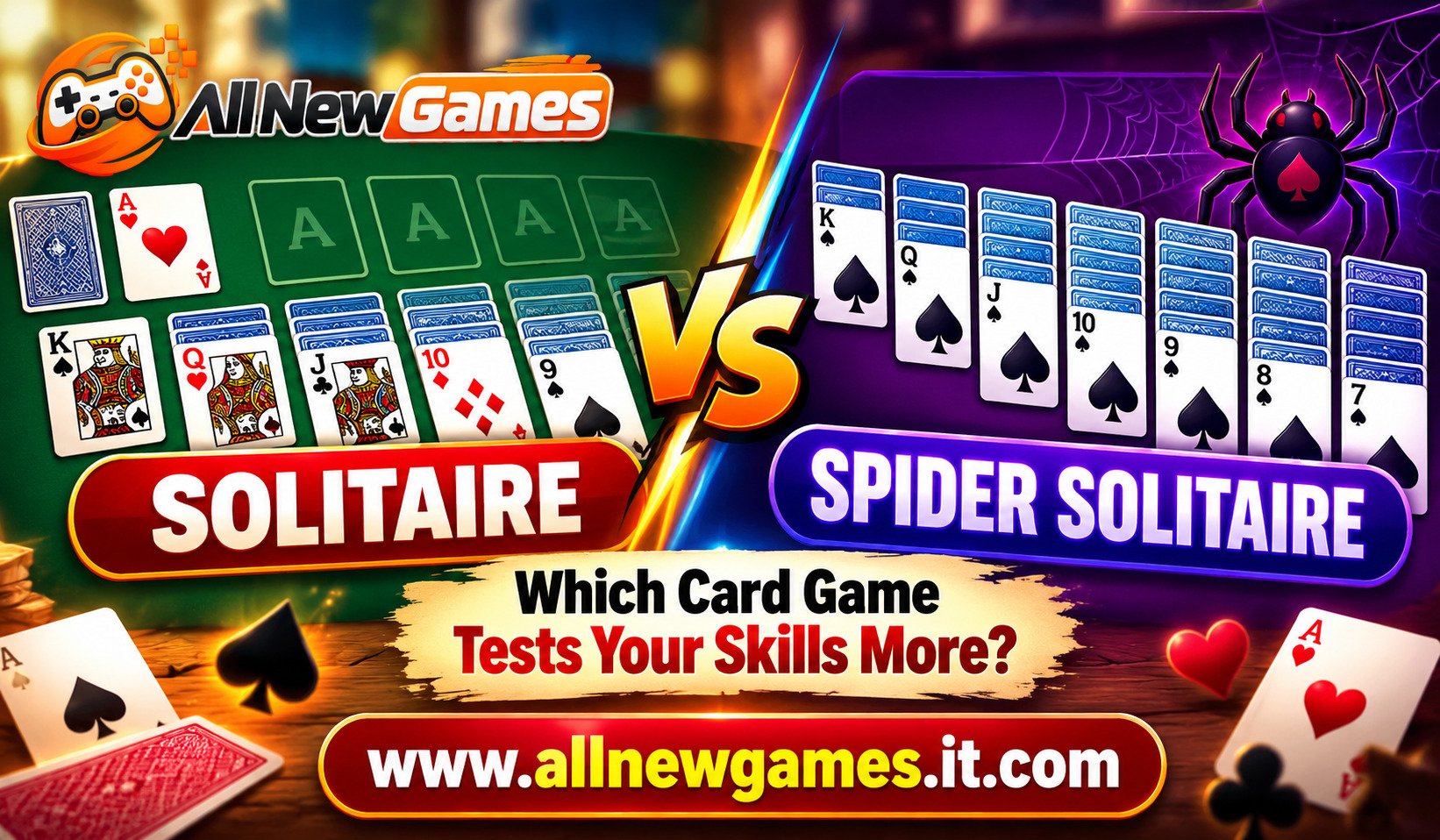
Card games have always been a popular way to relax, challenge your mind, and enjoy some quiet entertainment. Among the many options available, Solitaire and Spider Solitaire remain two of the most recognizable single-player card games. Both require patience, concentration, and logical thinking. However, they offer different levels of difficulty and test your card-playing abilities in different ways.
If you enjoy traditional Solitaire, you probably appreciate the satisfaction of arranging cards into perfectly ordered sequences. However, Spider Solitaire introduces additional challenges by requiring you to manage multiple card sequences and plan your moves more carefully. Although both games follow similar principles, their rules, strategies, and difficulty levels create very different experiences.
So, when comparing Solitaire vs. Spider Solitaire, which game actually tests your skills more? The answer depends on your experience, strategic thinking, and ability to manage complicated card arrangements. Let us explore their differences and discover which one provides the greater mental challenge.
1. Understanding the Basics of Solitaire
Traditional Solitaire, commonly known as Klondike Solitaire, is a single-player card game played with a standard 52-card deck. Your objective is to arrange all cards into four foundation piles, separated by suit and organized from Ace to King.
The game begins with seven tableau columns. Some cards are face-up, while the remaining cards are face-down. You can move cards between columns by arranging them in descending order and alternating colours.
For example, you can place a red 8 on a black 9. However, you cannot place a red 8 on another red card of a different rank.
You also use the stockpile to reveal additional cards when you cannot make useful moves within the tableau.
What Skills Does Solitaire Test?
Solitaire appears simple, but winning consistently requires several abilities:
- Logical thinking: You must identify which cards should move first to create useful sequences.
- Planning: You need to consider how each move affects your future options.
- Patience: Some games require several attempts before you find a winning sequence.
- Observation: You must remember available cards and identify opportunities hidden within the tableau.
The challenge comes from making the right decisions while working with limited information.
Popular Digital Card Games to Try
2. Understanding the Basics of Spider Solitaire
Spider Solitaire follows a different structure and generally offers a more demanding card-playing experience. It uses two standard decks, giving you 104 cards to organize.
Your objective is to build complete sequences from King down to Ace in the same suit. Once a complete sequence is formed, it is removed from the tableau.
The game usually begins with ten columns of cards. Some cards remain face-down, making it necessary to uncover them through careful moves.
One important difference is that Spider Solitaire allows you to move groups of cards when they form a valid descending sequence in the same suit. You can also place a card on another card of the next higher rank even when their suits differ, although mixed-suit sequences cannot be moved together as a complete group.
You can choose between three difficulty levels:
- One Suit: Uses one suit and is generally the easiest version.
- Two Suits: Introduces additional planning because you must manage two suits.
- Four Suits: Uses all four suits and provides a significantly greater challenge.
What Skills Does Spider Solitaire Test?
Spider Solitaire requires more detailed planning than traditional Klondike Solitaire.
You need to manage multiple sequences, uncover hidden cards, and decide when to create temporary arrangements. In addition, you must consider how moving one card affects several other columns.
Your ability to recognize patterns and organize cards efficiently becomes especially important when playing the four-suit version.
3. Solitaire vs. Spider Solitaire: Key Differences
Although both games involve arranging cards in descending and ascending sequences, their gameplay mechanics create different challenges.
| Feature | Solitaire (Klondike) | Spider Solitaire |
| Number of decks | 1 | 2 |
| Total cards | 52 | 104 |
| Main objective | Build four foundation piles | Complete eight same-suit sequences |
| Card arrangement | Alternating colours | Descending sequences |
| Difficulty | Easy to challenging | Easy to very challenging |
| Planning | Moderate | High |
| Main challenge | Managing available moves | Managing multiple sequences |
| Best for | Casual players | Strategy enthusiasts |
The most noticeable difference is the number of cards and the complexity of the arrangements. Spider Solitaire gives you more cards to manage, which increases the number of possible decisions.
However, traditional Solitaire can also become difficult when important cards remain hidden or when your available moves are limited.
4. Which Game Requires Better Strategic Thinking?
Both games reward strategic thinking, but Spider Solitaire generally demands more complex planning.
Strategic Thinking in Solitaire
In traditional Solitaire, your decisions often revolve around uncovering face-down cards, moving cards to foundation piles, and creating empty columns.
For example, moving a black Queen onto a red King might help you uncover another card. However, making that move without considering the remaining cards could limit your future options.
You must balance immediate progress with long-term opportunities.
Another important decision involves moving cards to the foundation piles. Although completing a foundation sequence is part of your objective, moving a card too early can sometimes prevent you from using it within the tableau.
Strategic Thinking in Spider Solitaire
Spider Solitaire requires you to think several moves ahead because individual decisions can affect multiple sequences.
For example, moving a card from one column might uncover a hidden card, but it could also break an existing sequence. You need to decide whether uncovering the card is worth disrupting your current arrangement.
Creating empty columns is another important strategy. These spaces allow you to temporarily move cards and reorganize sequences.
Furthermore, you must consider suit combinations carefully. Building same-suit sequences makes it easier to move groups of cards and complete full runs.
Winner: Spider Solitaire. Its larger card pool, multiple suits, and sequence-management requirements generally create a more demanding strategic experience.
5. Which Game Tests Your Memory and Concentration More?
Memory and concentration play important roles in both games.
In Solitaire, you need to remember cards revealed through the stockpile and identify opportunities when new cards become available. You also need to monitor the tableau to avoid overlooking useful moves.
Spider Solitaire introduces additional memory challenges because you manage ten columns and multiple sequences. Remembering which cards are hidden, which suits are developing successfully, and where useful cards are located can help you make better decisions.
Concentration is particularly important in the four-suit version. A single careless move may disrupt an arrangement that took several turns to build.
However, both games reward consistent attention rather than quick reactions.
Winner: Spider Solitaire. Managing more cards and multiple sequences places greater demands on your concentration and ability to track previous moves.
6. Which Game Is More Difficult to Win?
Difficulty depends on the version you choose and the cards dealt at the beginning.
Traditional Solitaire has a relatively straightforward objective, but not every deal is winnable. Your chances of success depend on card distribution, available moves, and the decisions you make.
Spider Solitaire offers a wider range of difficulty.
The one-suit version is generally accessible to beginners because you do not need to manage different suits. However, the four-suit version requires considerably more planning and careful sequence management.
You may need to reorganize several columns before completing even one full sequence.
| Difficulty Factor | Solitaire | Spider Solitaire |
| Beginner accessibility | High | Depends on suit setting |
| Sequence management | Moderate | High |
| Hidden-card management | Important | Very important |
| Long-term planning | Moderate | High |
| Overall challenge | Moderate | High in four-suit mode |
Winner: Spider Solitaire. Particularly at the four-suit level, it offers a more demanding challenge for experienced players.
7. Which Card Game Should Beginners Choose?
If you are new to digital card games, traditional Solitaire is usually the better starting point.
Its rules are relatively easy to understand, and you can learn important card movements without managing too many complicated sequences.
Once you become comfortable with the gameplay, you can gradually explore Spider Solitaire.
Starting with the one-suit version allows you to understand how sequences work. You can then progress to two suits and eventually four suits as your confidence improves.
Experienced players who already understand traditional Solitaire may find Spider Solitaire more rewarding because it introduces additional strategic decisions.
8. Tips to Improve Your Skills in Both Games
Regardless of which game you prefer, developing better habits can improve your performance.
Tips for Traditional Solitaire
- Prioritize moves that uncover face-down cards.
- Create empty tableau columns when they offer useful opportunities.
- Avoid moving cards to foundation piles automatically without considering their usefulness in the tableau.
- Pay attention to the stockpile and available card combinations.
Tips for Spider Solitaire
- Prioritize uncovering hidden cards whenever practical.
- Build same-suit sequences whenever possible.
- Use empty columns to reorganize complicated arrangements.
- Avoid dealing additional cards before considering your existing moves.
- Think carefully before breaking useful sequences.
The most important lesson is to avoid making moves simply because they are available. Consider how each decision affects your next few moves.
9. Can Playing Solitaire and Spider Solitaire Improve Your Thinking Skills?
Both games involve activities associated with logical reasoning, attention, planning, and problem-solving.
Solitaire encourages you to recognize patterns, evaluate available options, and make decisions based on limited information. Spider Solitaire adds another layer by requiring you to organize larger groups of cards and manage more complicated sequences.
These activities provide opportunities to practise concentration and strategic thinking.
However, playing card games should not be considered a guaranteed way to improve overall intelligence or prevent cognitive decline. Their main benefit is providing enjoyable mental challenges that encourage active decision-making.
Frequently Asked Questions
1. Is Spider Solitaire harder than regular Solitaire?
Yes, Spider Solitaire is generally more challenging, particularly when you play the four-suit version.
2. How many decks are used in Spider Solitaire?
Spider Solitaire uses two standard 52-card decks, containing 104 cards in total.
3. Which Solitaire game is better for beginners?
Traditional Klondike Solitaire is generally better for beginners because its rules and card arrangements are easier to understand.
4. Does Spider Solitaire require more strategy than Solitaire?
Yes, Spider Solitaire generally requires more strategic planning because you must manage multiple sequences, suits, and hidden cards.
5. Can you play Solitaire and Spider Solitaire online for free?
Yes, many websites and mobile applications offer free versions of both games, although some platforms include advertisements or optional paid features.
Conclusion
When comparing Solitaire vs. Spider Solitaire, both games provide enjoyable ways to challenge your mind, practise logical thinking, and improve your card-playing strategies.
Traditional Solitaire is an excellent choice if you prefer straightforward rules, manageable challenges, and relaxing gameplay. It rewards patience, observation, and smart decision-making.
Spider Solitaire, however, generally tests your abilities more intensely. Its larger deck, multiple sequences, and different suit combinations require greater concentration and more detailed planning.
If you are a beginner, start with traditional Solitaire and gradually explore Spider Solitaire. If you already enjoy card puzzles and want a tougher challenge, try the four-suit version.
Ultimately, the best game is the one that keeps you interested while encouraging you to think carefully about every move.