Card games are more than a source of entertainment. They challenge your ability to think ahead, recognize patterns, manage risks, and make decisions under pressure. Whether you enjoy arranging cards in Solitaire or competing against opponents in Poker, every game offers opportunities to develop smarter strategies. The more you understand the rules and mechanics, the better you become at identifying winning opportunities.
What makes card games particularly interesting is that different formats reward different skills. Some encourage patience and careful planning, while others require probability calculations, observation, and quick decisions. You might play a relaxing Solitaire session alone or join a competitive Poker table where every decision can influence the outcome.
If you want to improve your gameplay, understanding the strategies behind popular card games is a great starting point. From traditional classics to modern digital experiences, here are several card games that reward smart thinking and strategic decisions.
1. Solitaire: Develop Patience and Forward Planning
Solitaire is one of the most recognizable single-player card games. Although its rules appear simple, winning consistently requires careful planning and an understanding of how each move affects your available options.
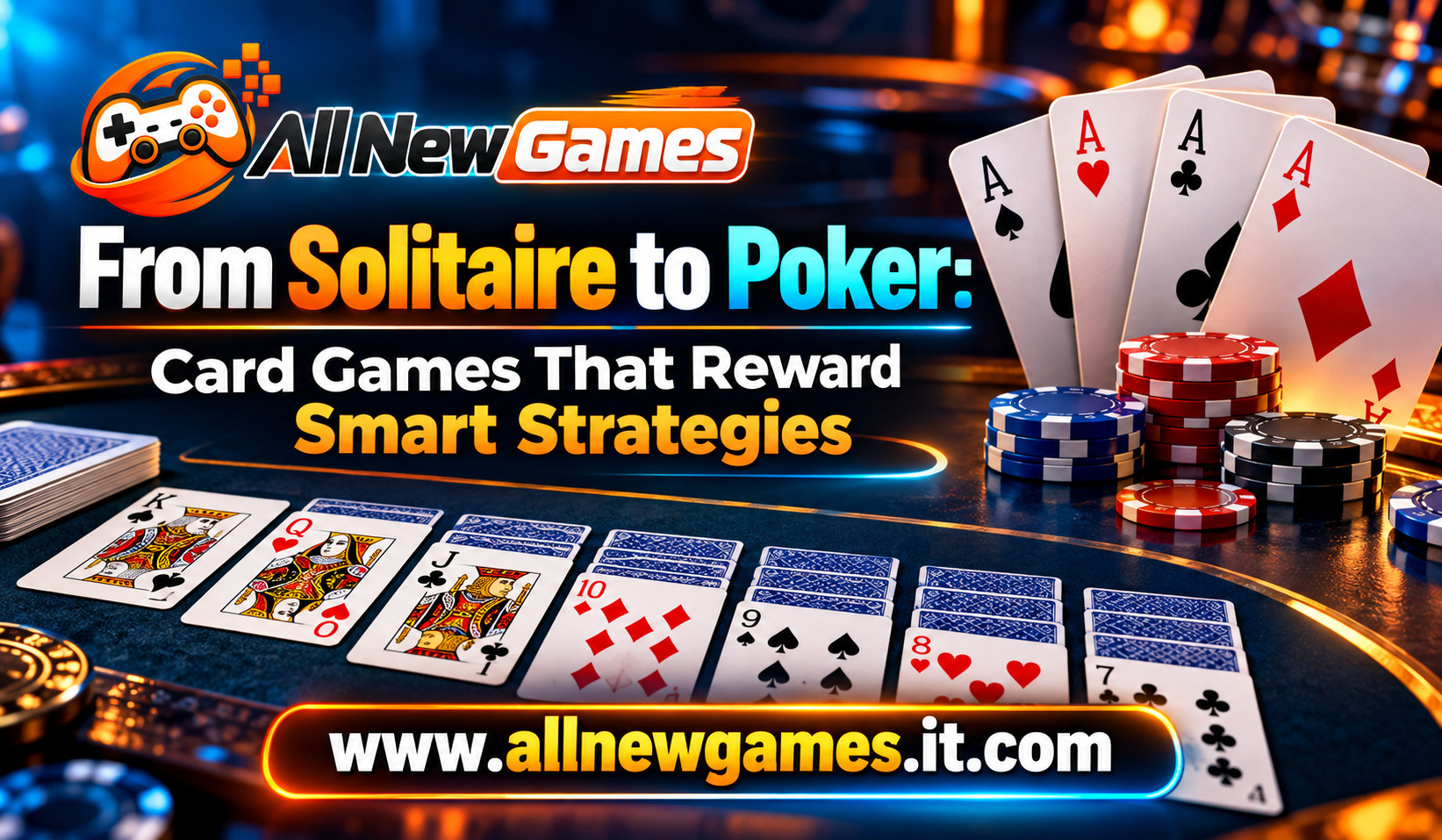
In traditional Klondike Solitaire, your objective is to organize cards into four foundation piles, arranged by suit from Ace to King. You need to move cards between columns while following alternating colours and descending numerical order.
However, moving a card immediately is not always the smartest decision. Sometimes, leaving a card in its current position creates better opportunities for future moves.
Strategies that improve your Solitaire gameplay:
- Prioritize uncovering face-down cards because they reveal additional playing opportunities.
- Avoid moving cards without considering how the decision affects other columns.
- Pay attention to empty columns because Kings can occupy these spaces.
- Plan foundation moves carefully when a card might still be useful in the tableau.
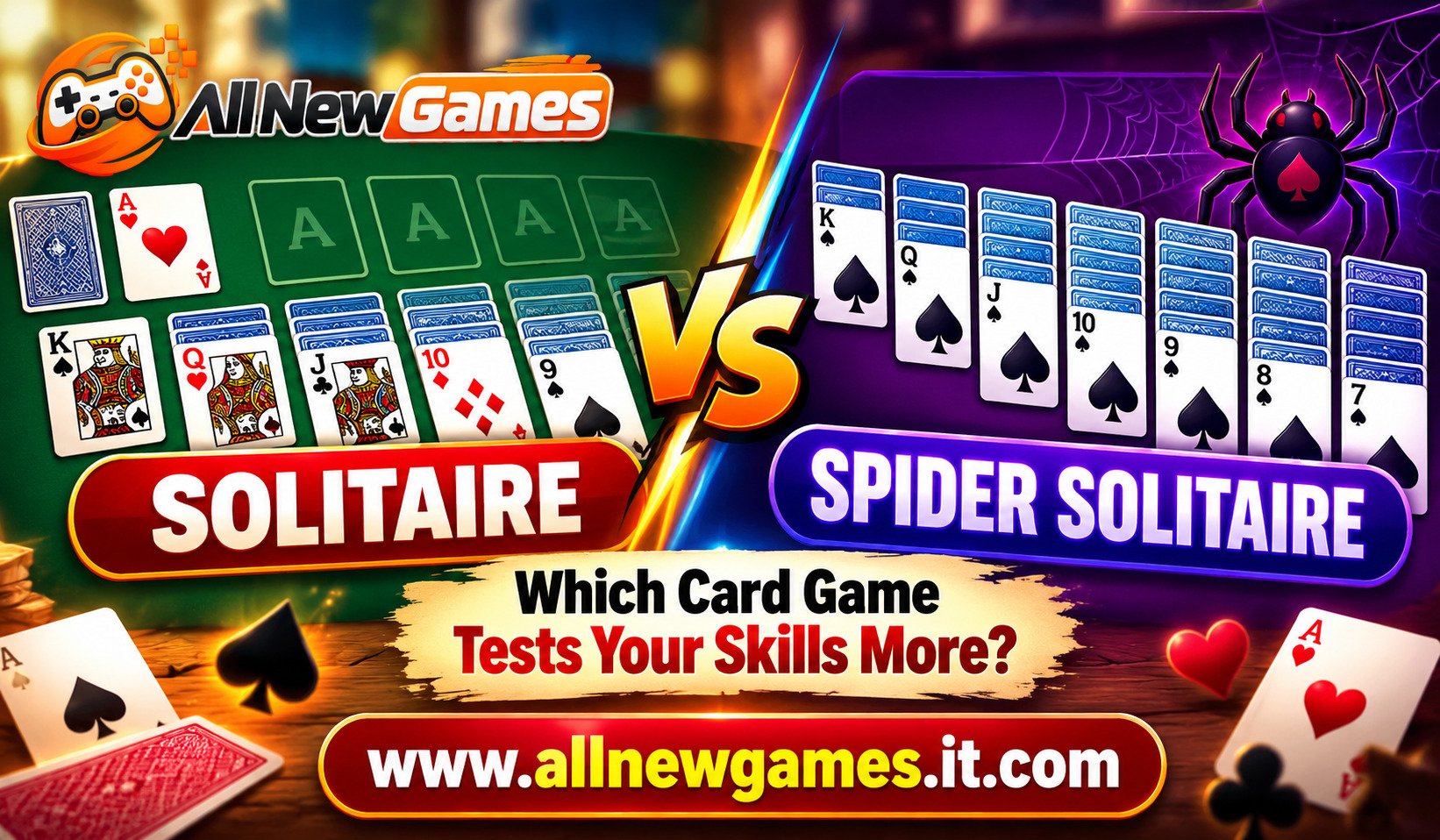
Spider Solitaire and FreeCell offer additional strategic challenges. Spider Solitaire rewards sequence management, while FreeCell encourages you to use available free cells efficiently.
Solitaire is particularly useful when you want to practise patience, logical thinking, and decision-making without competing against another player.
2. Poker: Master Probability and Read Your Opponents
Poker is a card game where strategy, probability, psychology, and risk management come together. Unlike Solitaire, you compete against other players, which means understanding your opponents can be just as important as understanding your cards.
Texas Hold’em is one of the most popular Poker variations. Each player receives two private cards and combines them with five community cards to create the strongest possible five-card hand.
However, having strong cards does not automatically guarantee success. Your decisions about betting, raising, calling, or folding influence how each hand develops.
Important Poker Strategies
Understand starting hands: Learn which starting hands offer stronger possibilities. Premium hands can justify more aggressive decisions, while weaker combinations often require caution.
Pay attention to position: Your position at the table affects how much information you have before making a decision. Acting later in a betting round generally gives you more information about other players’ actions.
Manage your bankroll: Set a playing budget and avoid risking money you cannot afford to lose. Good bankroll management helps prevent emotional decisions.
Recognize betting patterns: Observe how opponents behave in different situations. Their actions may provide useful clues, although betting patterns never reveal their cards with certainty.
Poker rewards players who combine mathematical thinking with disciplined decision-making. However, luck remains an important factor, particularly over individual hands.
3. Blackjack: Use Mathematics to Make Better Decisions
Blackjack is another popular card game that rewards strategic thinking. Your main objective is to achieve a hand value closer to 21 than the dealer without exceeding 21.
Number cards retain their face values, face cards count as 10, and Aces can count as either 1 or 11.
Although the game includes randomness, understanding basic strategy can help you make more informed decisions.
For example, you need to decide whether to hit, stand, double down, or split a pair. The right choice depends on your hand and the dealer’s visible card.
How to Improve Your Blackjack Decisions
- Learn a basic strategy chart for the specific Blackjack rules being played.
- Consider the dealer’s upcard before deciding whether to hit or stand.
- Understand when splitting pairs can be beneficial.
- Avoid making decisions based on previous wins or losses.
Basic strategy uses mathematical analysis of possible outcomes to identify stronger decisions. Nevertheless, it does not guarantee a win or eliminate the house advantage.
Blackjack is a good option if you enjoy probability, numerical reasoning, and making decisions with incomplete information.
4. Bridge: Build Communication and Partnership Skills
Bridge stands out because it combines card strategy with teamwork. It is generally played by four people divided into two partnerships.
The game involves bidding, contract selection, and playing tricks. During the bidding stage, partners communicate information about their hands through an agreed system of bids.
Once a contract is established, the partnership attempts to fulfil its objective by winning the required number of tricks.
Unlike many casual card games, Bridge rewards long-term learning and cooperation. You need to understand your partner’s bids, remember played cards, and anticipate how opponents might respond.
Smart Bridge strategies include:
- Learning common bidding conventions.
- Remembering which important cards have already been played.
- Communicating through legal bidding information.
- Planning how to win tricks before playing your cards.
Bridge is particularly appealing if you enjoy complex puzzles and games that require cooperation rather than individual decision-making.
5. Rummy: Improve Observation and Card Management
Rummy is a popular family of card games built around forming valid combinations. Depending on the variation, you typically create sets of matching ranks or sequences of consecutive cards from the same suit.
Your objective is to organize your cards into the required combinations while reducing the number of unmatched cards.
However, successful Rummy gameplay involves more than collecting cards randomly. You need to observe what other players pick up and discard, recognize useful combinations, and avoid giving opponents cards they need.
Strategies for Better Rummy Gameplay
Organize your cards: Arrange your hand into possible sequences and sets so you can quickly identify useful combinations.
Prioritize sequences: In many Rummy variations, forming a valid sequence is an important requirement for declaring successfully.
Watch discarded cards: The discard pile provides information about cards that other players may not need.
Replace weak combinations: Avoid holding onto combinations that have little chance of becoming useful.
Rummy rewards observation, flexibility, and thoughtful card management. It is also an accessible choice for players who want to practise strategic thinking in a social setting.
6. Hearts: Think Ahead and Control Risk
Hearts is a trick-taking card game that rewards careful planning and risk management. It is generally played by four players, with the objective of finishing with as few penalty points as possible.
Most hearts cards carry one penalty point each, while the Queen of Spades carries 13 penalty points under standard rules.
Your challenge is to avoid collecting unwanted penalty cards. However, certain strategies can help you control the flow of a round.
For example, paying attention to which suits other players cannot follow can provide useful information. You can also decide when to play high-value cards or avoid taking a particular trick.
Another interesting strategy is shooting the moon, which involves collecting all the penalty cards in a round. If successful, it changes the scoring dramatically.
Hearts encourages you to think several moves ahead and recognize situations where avoiding a risk is more valuable than chasing an immediate advantage.
7. Cribbage: Combine Memory, Counting, and Planning
Cribbage is a traditional card game that combines card combinations with a distinctive scoring system. It is commonly played between two players, although other formats are available.
Players score points by creating combinations such as pairs, runs, and combinations that total 15. The game also uses a pegging board to track scores.
Cribbage requires you to make decisions during both the hand-selection and playing stages.
For example, when discarding cards into the crib, you need to consider which cards might create useful combinations. You must also think about whether the crib belongs to you or your opponent.
During pegging, remembering previously played cards can help you identify scoring opportunities and avoid giving your opponent easy points.
Cribbage is a rewarding option if you enjoy numerical puzzles, memory challenges, and planning several moves ahead.
Comparing Card Games and the Skills They Reward
Different card games develop different strategic abilities. The following comparison can help you decide which experience suits your interests.
| Card Game | Main Strategic Skill | Playing Style |
| Solitaire | Planning and patience | Single-player |
| Poker | Probability and risk management | Competitive |
| Blackjack | Mathematical decisions | Dealer-based |
| Bridge | Communication and teamwork | Partnership |
| Rummy | Observation and card management | Competitive |
| Hearts | Risk assessment and planning | Multiplayer |
| Cribbage | Memory and numerical reasoning | Competitive |
How to Become Better at Strategic Card Games
Learning the rules is only the first step. If you want to improve your performance, focus on developing habits that help you make better decisions.
Understand the Rules Before Developing Strategies
Every card game has its own mechanics, scoring systems, and restrictions. Understanding these details helps you avoid unnecessary mistakes and recognize opportunities that might otherwise go unnoticed.
Start with the basic rules and gradually explore advanced techniques.
Practise Consistently
Regular practice helps you become familiar with common situations. You can start with simpler challenges and gradually move towards more competitive games.
Digital versions are particularly convenient because they often allow you to practise against computer-controlled opponents or participate in online matches.
Learn From Your Mistakes
Instead of focusing only on wins and losses, review the decisions you made during each game.
Ask yourself whether a different move could have produced a better outcome. This approach helps you recognize repeated mistakes and improve your decision-making.
Balance Patience With Calculated Risks
Strategic games often require you to decide when to wait and when to act. Making aggressive moves without considering possible consequences can create unnecessary problems.
Therefore, evaluate your available options before committing to a decision.
Frequently Asked Questions
1. Which card games require the most strategic thinking?
Bridge, Poker, Cribbage, and advanced Solitaire variations offer considerable strategic depth through planning, probability, memory, and decision-making.
2. Can playing card games improve your thinking skills?
Card games can encourage logical reasoning, concentration, memory, pattern recognition, and problem-solving through regular mental challenges.
3. Is Poker more about luck or strategy?
Poker involves both luck and strategy, but probability, position, opponent observation, and disciplined decisions influence long-term performance.
4. Which card game is best for beginners?
Solitaire, Rummy, and Blackjack are accessible starting points because their basic rules are relatively straightforward to learn.
5. Are digital card games useful for practising strategies?
Yes, digital card games provide convenient opportunities to practise different techniques, explore game mechanics, and learn from repeated gameplay.
Conclusion
From Solitaire to Poker, card games offer exciting ways to challenge your mind and develop smarter playing habits. Each game rewards a different combination of skills, whether you are organizing cards, calculating probabilities, observing opponents, or working with a partner.
Solitaire helps you develop patience and forward planning, while Poker encourages disciplined risk management. Meanwhile, Bridge highlights teamwork, Rummy improves observation, and Cribbage combines memory with numerical reasoning.
The best approach is to explore different card games and discover which challenges interest you most. Learn the rules, practise regularly, and review your decisions after every session. With time and experience, you can become a more thoughtful player and enjoy the strategic depth that makes card games so engaging.