Introduction
Mobile gaming continues to introduce new ways to entertain players, but some of the most interesting trends come from surprisingly simple ideas. Arrow Puzzle Games are a good example. These games combine colourful arrows, clever layouts, and challenging movement patterns to create an enjoyable experience that keeps you thinking. Although the basic concept is easy to understand, completing increasingly complicated levels requires patience, observation, and logical thinking.
Unlike traditional action games, arrow-based puzzles do not always depend on quick reactions or complicated controls. Instead, you must study the board, identify blocked paths, and decide which arrow should move first. Every successful move changes the puzzle and creates new opportunities.
This combination of simplicity and strategic thinking is attracting attention among mobile puzzle enthusiasts. Whether you want a short gaming break or a challenging activity to exercise your problem-solving skills, arrow puzzles offer an interesting experience. So, what makes this growing puzzle trend worth exploring?
What Are Arrow Puzzle Games?
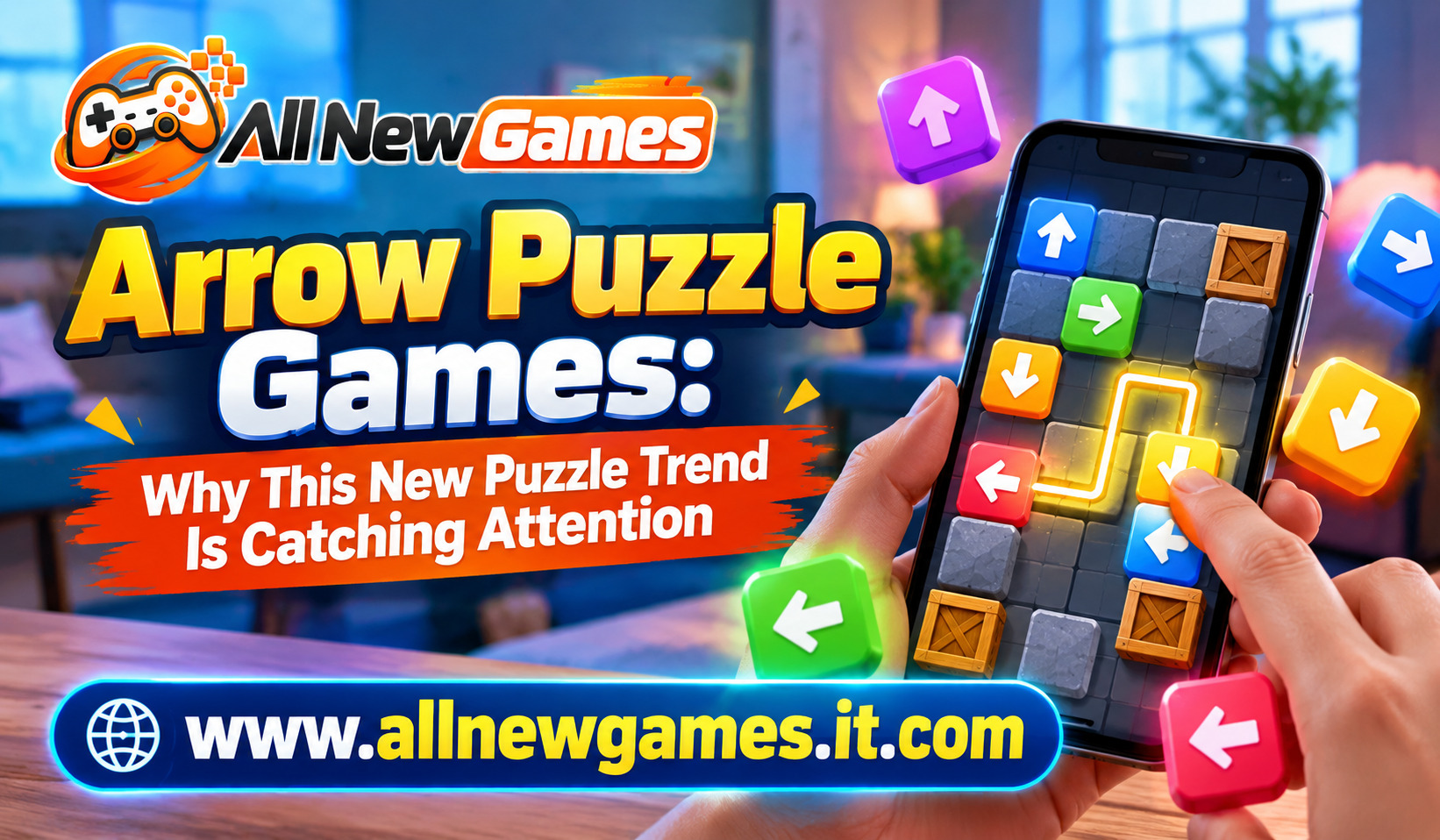
Arrow Puzzle Games are logic-based games in which you must move or remove arrows from a board by following their indicated directions. Depending on the version, the arrows may appear as individual pieces, connected shapes, or colourful directional objects.
The main objective is usually to clear the entire board. However, you cannot simply select arrows randomly. Each arrow has a specific direction, and another object may block its route. Therefore, you must identify which arrows can move safely before attempting to clear the remaining pieces.
For example, imagine a board filled with arrows pointing up, down, left, and right. An arrow pointing towards the right edge cannot escape if another arrow blocks its path. You must first remove the obstacle before that arrow can move.
This simple rule creates several possible challenges. Some levels contain only a few arrows, while others feature complicated arrangements that require careful planning.
How Do These Games Work?
Most arrow escape puzzles follow a straightforward gameplay structure:
- Examine the board and identify the direction of each arrow.
- Find an arrow with a completely clear path.
- Tap or select that arrow to remove it.
- Check which new paths become available.
- Repeat the process until the board is empty.
Some versions introduce additional elements, including obstacles, special movement rules, limited mistakes, hints, and increasingly complicated layouts.
Although the controls are simple, choosing the correct sequence is what makes the experience challenging.
Why Are Arrow Puzzle Games Catching Attention?
The growing interest in arrow puzzles comes from their ability to make simple gameplay feel rewarding. They offer a different experience from games that depend heavily on competition, fast movement, or complicated instructions.
Here are several reasons why players are becoming interested in this puzzle format.
1. Simple Rules Make Them Easy to Understand
One major advantage is accessibility. You do not need extensive gaming experience to understand the basic objective. Most versions introduce their central mechanic through simple instructions or beginner-friendly levels.
You can usually start playing within moments of opening the game. There is no need to memorise complicated combinations or spend a long time learning different controls.
However, understanding the rules does not mean every level will be easy. As you progress, the arrangements become more complicated, encouraging you to think carefully before making a move.
This balance makes arrow puzzles suitable for casual players as well as people who regularly enjoy logic games.
2. Every Move Requires Logical Thinking
Arrow puzzles are not simply about tapping objects until something happens. Your success depends on understanding how different pieces interact.
For instance, removing one arrow may open the path for several other arrows. Meanwhile, selecting the wrong piece too early could leave important objects blocked.
Consequently, you need to think about the consequences of each decision.
This creates an interesting problem-solving experience. You gradually learn to recognise patterns, identify obstacles, and understand which moves will make the biggest difference.
If you enjoy Sudoku, sliding-block puzzles, or other logic-based challenges, this style of gameplay may appeal to you.
3. Short Levels Fit Into Busy Schedules
Another reason for their appeal is convenience. Many mobile arrow puzzles divide gameplay into individual levels that you can complete during short breaks.
You might play while waiting for an appointment, travelling, or relaxing after work. You do not necessarily need to commit to a lengthy gaming session.
Additionally, the straightforward controls make it easy to return to a puzzle whenever you have free time.
However, some difficult levels may take longer than expected. The experience depends on the complexity of the board and how quickly you identify the correct sequence.
4. Satisfying Visual Feedback Makes Progress Enjoyable
Visual presentation plays an important role in puzzle games. Watching arrows disappear one by one creates a clear sense of progress.
Many games also use colourful designs, smooth animations, and sound effects to make successful moves feel rewarding.
As the board becomes less crowded, you can immediately see how your decisions have changed the puzzle.
Furthermore, some variations introduce picture-based levels in which removing arrows gradually reveals a hidden design. These additional visual elements provide another reason to continue playing.
5. Difficulty Creates a Reason to Keep Playing
A good puzzle game needs more than easy beginner levels. It should gradually introduce challenges that encourage players to improve their strategies.
Arrow puzzles achieve this through increasingly complicated arrangements, longer arrows, limited mistakes, and additional obstacles.
At first, you may only need to identify a few available moves. Later, however, you might need to plan several steps ahead.
This progression makes the experience more interesting because you can recognise your improvement as you advance.
Different Types of Arrow Puzzle Games You Can Explore
Not every arrow-based puzzle offers exactly the same experience. Developers experiment with different layouts, visual styles, and mechanics to create variety.
Here are four common puzzle styles worth understanding.
1. Classic Arrow Escape Puzzles
These games focus on removing arrows from a crowded board. Each arrow must follow its indicated direction, and you must ensure its path is clear before selecting it.
The challenge comes from identifying the correct removal sequence.
2. Colour-Based Arrow Puzzles
Colour-based versions combine directional movement with colour recognition. You may need to match arrows with particular exits, gates, or designated areas.
These games introduce another layer of decision-making because you must consider both direction and colour.
3. 3D Arrow Puzzles
Three-dimensional variations add depth to the traditional format. Instead of examining a flat board, you may need to rotate an object to understand how its arrows are positioned.
This requires spatial awareness because some obstacles may become visible only when you change your viewing angle.
4. Sliding-Block and Directional Puzzles
These games share similarities with traditional sliding-block challenges. Instead of removing every arrow, you may need to move directional pieces around obstacles to create an open route.
They offer a slightly different experience while maintaining the same emphasis on planning and logical thinking.
Popular Examples Worth Exploring
If you want to understand how this puzzle category works in practice, several mobile games provide useful examples.
| Game | Main gameplay experience |
| Arrows – Puzzle Escape | Clear directional arrows by selecting them in the correct order. |
| Arrow Puzzle – Tap Away Game | Remove arrows from a crowded arrangement. |
| Amaze GO! | Solve directional and sequencing challenges. |
| Unblock Me | Move blocks strategically to create an exit path. |
These examples demonstrate how developers use directional movement and obstacle-based challenges to create different puzzle experiences.
Although Unblock Me is not technically an arrow puzzle, it belongs to the broader sliding-block puzzle family that helped establish this style of mobile gameplay.
How Arrow Puzzle Games Can Support Your Thinking Skills
Puzzle games provide opportunities to practise different types of mental activity. Arrow-based challenges are particularly interesting because they combine observation, planning, and decision-making.
Improving Observation
You must carefully examine the board before making a move. This encourages you to notice directions, blocked routes, and possible opportunities.
Over time, you may become more comfortable identifying useful patterns in complicated layouts.
Developing Strategic Planning
Every move can influence what happens next. Therefore, you need to consider the possible consequences before selecting an arrow.
For example, removing an arrow that blocks three other pieces may be more useful than selecting one that can escape without changing the rest of the board.
Practising Patience
Some levels require several attempts before you understand the correct sequence. Instead of rushing, you need to examine the available options and learn from mistakes.
This makes the experience particularly suitable when you want a slower alternative to fast-paced mobile games.
It is important to remember that playing puzzles does not guarantee improvements in general intelligence or long-term cognitive performance. However, these games provide an enjoyable way to practise specific reasoning and problem-solving activities.
Practical Tips to Solve Difficult Arrow Puzzles
If you are new to this gaming trend, a few simple habits can make your experience easier.
- Start with the outer edges: Look for arrows that already have clear routes towards the board boundaries.
- Check the entire path: Do not focus only on the arrowhead. Examine the space between the arrow and its exit.
- Think about future moves: Consider whether removing one arrow will open routes for other pieces.
- Use hints carefully: If the game offers hints, save them for situations where you cannot identify a safe move.
Most importantly, avoid tapping randomly. A few seconds of observation can prevent unnecessary mistakes and help you understand the puzzle more effectively.
What Makes Arrow Puzzle Games Different From Traditional Mobile Games?
Traditional mobile games often focus on action, competition, collecting rewards, or completing missions. Arrow puzzles offer a more focused experience.
Their main attraction is the challenge of finding a solution rather than defeating another player or reaching a particular score.
They also have relatively straightforward controls. You generally need to tap, select, or rotate objects instead of learning complicated combinations.
However, simplicity does not mean a lack of variety. Developers can introduce new board shapes, movement restrictions, visual effects, and additional obstacles without changing the basic concept.
This flexibility allows the genre to appeal to different types of puzzle enthusiasts.
What Should You Look for When Choosing an Arrow Puzzle Game?
If you are planning to try this category, consider the overall gameplay experience rather than judging a game entirely by its screenshots.
Look for the following features:
- Gradual difficulty: Good level progression introduces new challenges without making every stage frustrating.
- Clear controls: You should understand how arrows move and what happens when a path is blocked.
- Useful hints: Optional assistance can help you understand difficult levels without removing the challenge.
- Comfortable design: Readable arrows, clear colours, and smooth animations make longer sessions more enjoyable.
You should also check user reviews and the game’s advertising or in-app purchase policies before installing it.
A well-designed puzzle should make you want to solve another level because the challenge is enjoyable, not because the game constantly pressures you to continue.
Frequently Asked Questions (FAQs)
1. What are Arrow Puzzle Games?
Arrow Puzzle Games are logic-based challenges in which you move or remove directional arrows by finding the correct sequence of moves.
2. Are Arrow Puzzle Games suitable for beginners?
Yes, most versions offer simple instructions and introductory levels that help new players understand the basic mechanics.
3. Do Arrow Puzzle Games require an internet connection?
Some games support offline gameplay, while others may require an internet connection for certain features, advertisements, or progress synchronisation.
4. Do Arrow Puzzle Games improve problem-solving skills?
They provide opportunities to practise logical reasoning, spatial awareness, observation, and strategic planning, although benefits outside the game are not guaranteed.
5. Are Arrow Puzzle Games free to play?
Many mobile versions are free to download, but some include advertisements, optional purchases, hints, or other paid features.
Conclusion
Arrow Puzzle Games demonstrate how a simple concept can create an engaging mobile gaming experience. Their directional mechanics, colourful layouts, and increasingly complicated challenges offer an interesting alternative to traditional casual games.
The biggest attraction is the combination of accessibility and strategic thinking. You can understand the basic rules quickly, but solving difficult levels requires patience, careful observation, and the ability to plan ahead.
Whether you enjoy traditional sliding-block puzzles or want to discover something different, this growing puzzle category is worth exploring. As developers continue experimenting with new layouts, 3D environments, and creative gameplay features, arrow puzzles have plenty of opportunities to keep attracting curious players.
Ultimately, the appeal is straightforward: every arrow has somewhere to go, but finding the right order is entirely up to you.