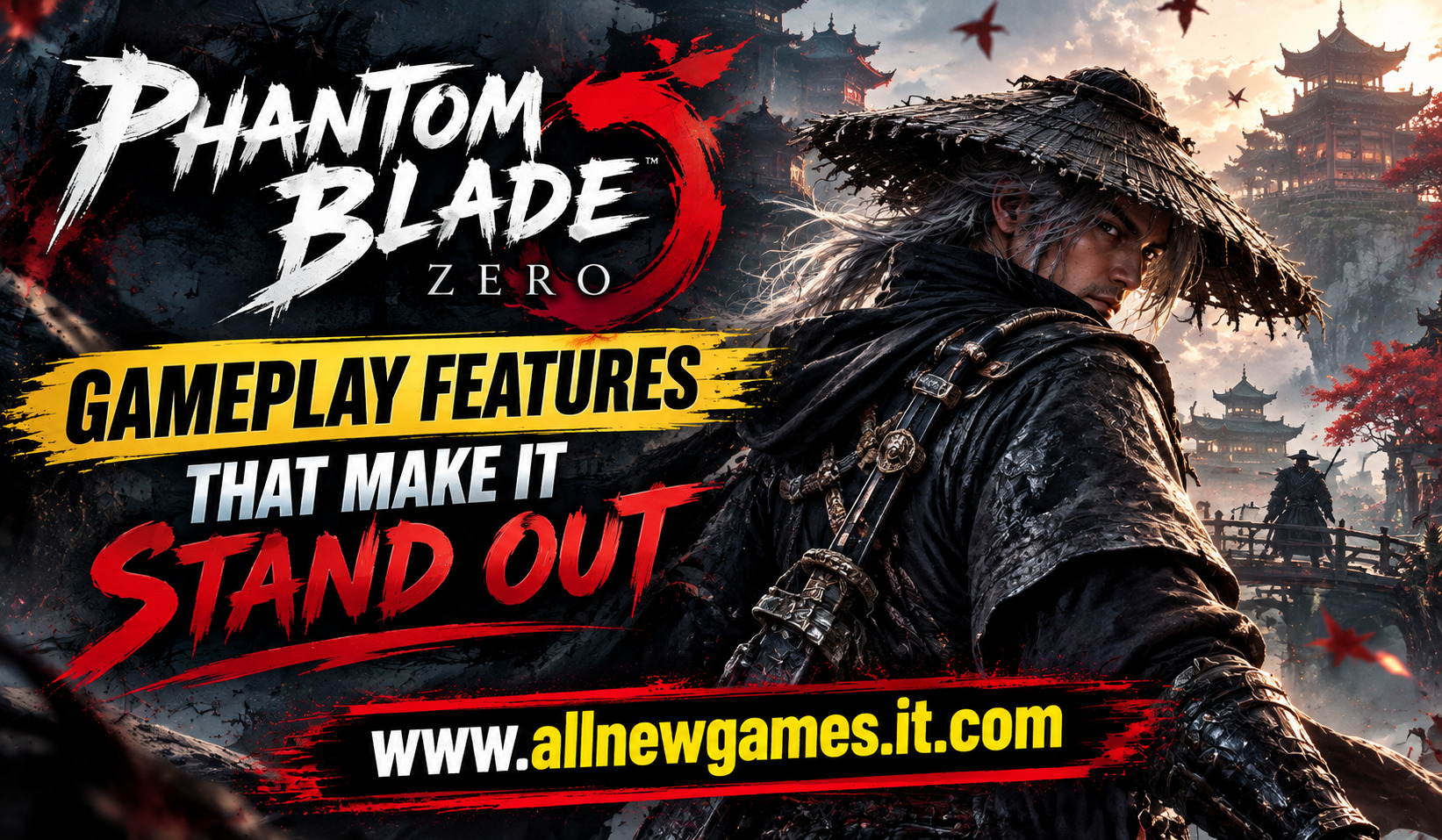
Phantom Blade Zero gameplay lets you fight like a kung fu film, and launch is weeks away. S-Game’s action RPG arrives on October 29, 2026, for PlayStation 5 and PC, so real details now matter. Because several hands-on demos have gone public, the Phantom Blade Zero gameplay picture is clearer than ever. Once you know the facts, you can judge whether the hype fits your taste.
Because the game has many moving parts, this guide covers weapons, defense, bosses, and progression. Beyond that, it explains the difficulty modes and the shape of the world. Along the way, I will separate confirmed details from early impressions, so you can trust each claim. That includes a few spots where previews disagree.
What Phantom Blade Zero gameplay looks like
Phantom Blade Zero is a single-player, third-person action RPG from the Beijing studio S-Game. Because the developers call the style kungfupunk, kung fu mixes with steampunk machinery. Even so, the core is fast, combo-driven swordplay. One preview reviewer compared the feel to Ninja Gaiden more than Dark Souls.
Many players expect a Souls-like, yet previews push back on that label. A Summer Game Fest hands-on said the game is not just a Soulslike. Meanwhile, a State of Play recap from Beebom said it is not a Souls-like at all. Still, I think the comparison helps newcomers, since every fight demands attention.
The game runs on Unreal Engine 5, and a motion capture team in Shanghai records the fights. Because of that, animation looks closer to real martial arts than to stiff video game swings. One hands-on praised the strong animation and fight choreography, which fits that goal. Besides, Donnie Yen serves as creative consultant, so the choreography has a famous name behind it.
| Detail | Info |
| Release date | October 29, 2026 |
| Platforms | PlayStation 5 and PC |
| Genre | Single-player third-person action RPG |
| Developer | S-Game |
| Price | $59.99 Standard, $69.99 Digital Deluxe |
Four weapons in one fluid loadout
Players carry two primary weapons and two secondary weapons at once, so no fight needs a single tool. The primary slots hold blades and heavier arms, while the secondary slots hold tools called Phantom Edges. The table below shows a few examples from trailers and previews.
| Weapon or style | What it does |
| White Serpent and Crimson Viper | Twin blades, and the Viper orbits Soul to slash enemies |
| Soft Snake Sword | Twists around other attacks to land a clean hit |
| Iron fists | Deliver heavy attacks |
| Tiger Cannon | Blasts groups of enemies |
| Flaming Mane | Shoots fire from a giant mask |
| Drunken Sword style | Builds drunken energy while Soul weaves and dodges |
S-Game says the full game has more than 30 main weapons and 25 secondary weapons. Each one draws on Chinese folklore and has its own attack patterns. Because of that, not every weapon works against every enemy. For instance, hammers handle shielded foes well.
You can swap weapons mid-fight to chain combos and break enemy guard. That swap restores stamina and triggers a flourish, although a cooldown stops you from spamming it. Heavy weapons feel weighty, while twin blades feel faster and flashier. I like that the choice changes your rhythm, not just your damage numbers.
Sha-chi, parries, and the ghostep
Defense is where this combat system finds its personality. Sha-chi works like a stamina bar for both you and your enemies, so every exchange has a cost. It fuels heavy attacks and blocking, while a drained enemy becomes open to finishers.
Reading the colors
Enemy attacks carry color cues. Brutal moves are marked blue, so you parry them. Killer moves are marked red, so you dodge them because they cannot be blocked or parried. Blocking a brutal move still works, although it drains your sha-chi.
The ghostep payoff
Time a parry or dodge just before impact, and a ghostep moves you behind the enemy. From there, a backstab drains enemy sha-chi. Once an enemy runs dry, you can finish it, although bosses can only be executed in their final health phase.
One hands-on reported that holding L1 deflects attacks. Blocking at the right moment then becomes a parry that depletes enemy guard. Some attacks demand a parry, while others demand a perfect dodge. That reviewer even dodged a thrown TNT stick and threw it back.
Enemy groups also use formation logic, so several attackers may actually share one move. Because of that, a crowd fight reads more like a dance than a brawl. Of course, only the full game will show how well that holds up.
I should also mention the learning curve. Because new enemy types demand attention, early fights may feel harsh. Even so, one preview called the combat more accessible than typical Souls-likes while still tough for veterans. That balance matters, since a game this flashy could easily overwhelm newcomers. Meanwhile, the difficulty modes exist to soften or sharpen the experience.
Bosses that read your habits
Bosses carry much of the challenge, and S-Game wants them to feel alive. On Hellwalker difficulty, bosses react to your attack patterns instead of following fixed scripts. As a result, spamming one trick should stop working fast. The table lists three bosses from early demos.
| Boss | What previews showed |
| Tie Sha | Introduces the core mechanics |
| Commander Cleave | Uses long-range attacks and AI that adapts to your position |
| Huangxing | Can one-shot you with Flying Guillotines, so timing matters |
A roughly 15-minute Summer Game Fest demo held a tutorial, a short level, and a boss. Then two more boss fights followed, each with a different weapon loadout. Because the demo was short, it hid most of the world and the progression systems.
Levels also hide secret bosses and weapons, which rewards curious players. That said, I would not expect every secret to be easy to find. After all, handcrafted levels usually reward patience more than speed.
Skills, upgrades, and reforging
Progression starts with a skill tree that strengthens Soul over time. Weapons grow too, because upgrades unlock new forms and techniques. Accessories, summons, and ranged tools can join the mix, so builds can vary widely.
Upgrades cost materials, yet reforging lets you recover them. As a result, a failed build does not lock you in. That said, I would still test new weapons early, since the full tree has not been shown.
Death is also gentler on your inventory. According to one preview, dying does not cost useful resources, and checkpoints are forgiving. Even so, moment-to-moment combat stays tough, especially against new enemies. A leveling system with stat points is also reported for the full game, although the demo did not show it.
Weapon forms deserve a closer look. Because upgrades unlock new techniques, a weapon you dislike at first may change with investment. In other words, early impressions can mislead, so give each weapon a fair trial. Meanwhile, accessories add another layer to build choices.
Difficulty modes and the 66 Days challenge
S-Game offers four difficulty modes, so players can pick their own level of pain. Hellwalker makes enemy AI smarter and adaptive, while 66 Days adds a clock on top. Because each death costs a day, the countdown adds real pressure. New Game Plus unlocks after a first playthrough, so there is a reason to return.
Beyond that, the modes shape the mood of the story. Wayfarer suits players who want the plot and the spectacle, while Hellwalker suits players who want a duel. Because 66 Days uses the same clock as the plot, it may feel the most faithful to the premise. Even so, I would play on a lower mode first, since learning the systems comes before mastering them.
| Mode | What changes |
| Wayfarer | Story-focused, built to make you feel like a kung fu god |
| Pathbreaker | Sits between Wayfarer and Hellwalker |
| Hellwalker | Smarter, adaptive enemy AI and bosses that react to your style |
| 66 Days | Hellwalker rules plus a life timer where each death costs one day |
A connected world with handcrafted levels
The world has eight interconnected regions. It is not open world, yet it is not fully linear either. Some areas open later through non-linear routes, which rewards exploration. Because levels are handcrafted, secrets feel placed rather than scattered.
Bells let you fast travel between regions, and an ink-drawn map helps with direction. Lakes add variety, since you can ride a speedboat-like vessel across them. Meanwhile, side quests are more than filler, since some open story paths and affect the main plot. The story can end in one of eight endings.
Mixtape Could Be One of the Most Interesting Narrative Games of 2026
Key Takeaways
- Release: October 29, 2026, on PlayStation 5 and PC
- Loadout: Two primary weapons and two secondary Phantom Edges
- Defense: Parry blue attacks, dodge red ones, and chase the ghostep
- Bosses: On Hellwalker, they adapt to your habits
- Hardest mode: 66 Days, with a death countdown
- World: Eight connected regions with handcrafted levels
Frequently Asked Questions
When does Phantom Blade Zero launch?
While Xbox players wait, Phantom Blade Zero launches on October 29, 2026, on PlayStation 5 and PC.
Is Phantom Blade Zero a Souls-like?
Although it shares tough fights, previews describe it as more aggressive than a Souls-like.
How many weapons can you carry?
You carry two primary and two secondary weapons, so swapping is part of every fight.
What is the hardest difficulty mode?
Because 66 Days adds a death countdown to Hellwalker rules, it is the toughest mode.
How much does Phantom Blade Zero cost?
The Standard Edition costs $59.99, while the Digital Deluxe Edition costs $69.99.
Conclusion
Phantom Blade Zero gameplay mixes fast swordplay with a tight defense system and flexible loadouts. Because bosses adapt on higher difficulties, no single trick should carry you through the story. Still, previews were short, so the full game must prove the depth that the weapons list promises. If it does, this action RPG could be one of the most memorable launches of the year.