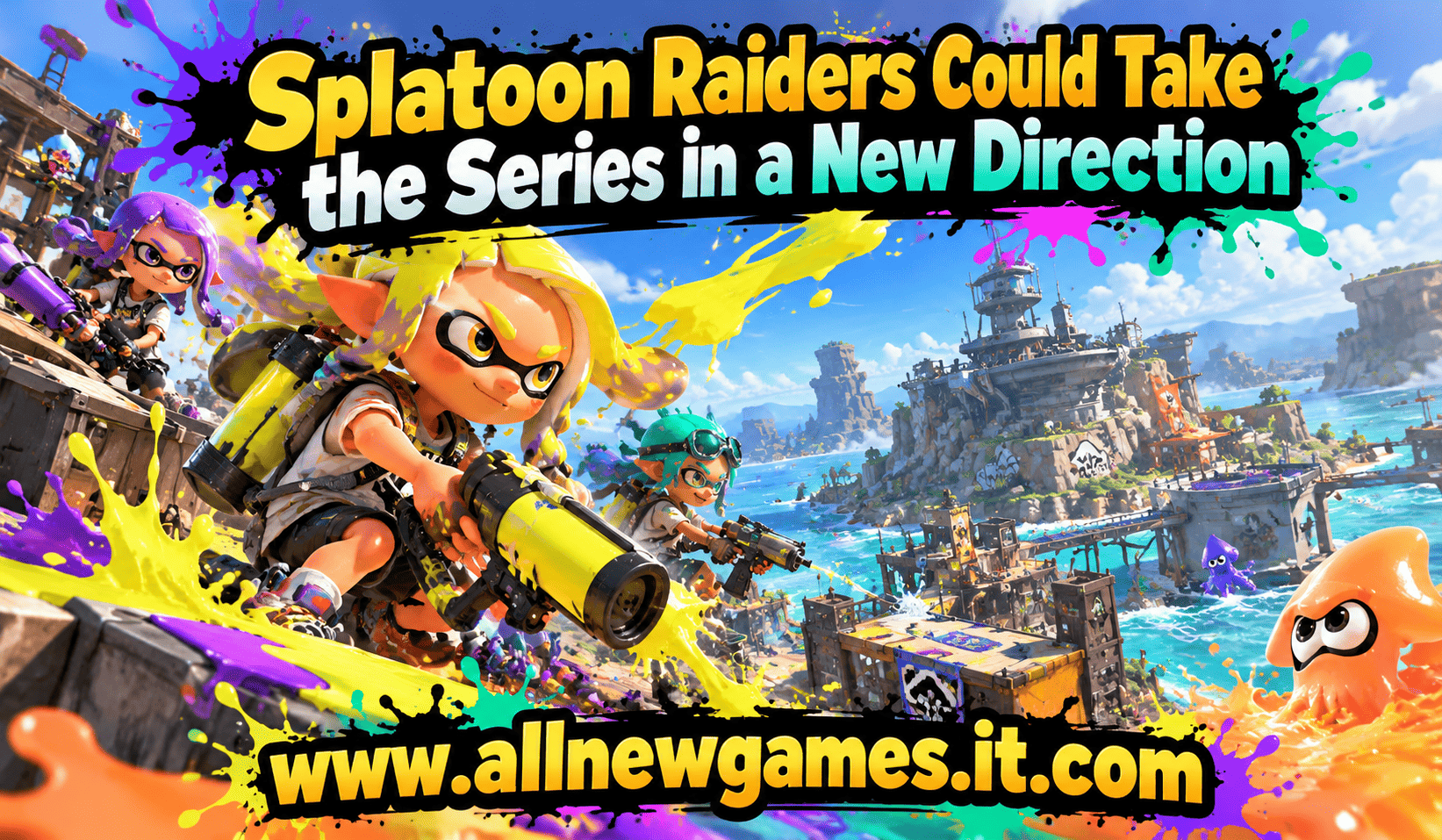
The Splatoon franchise has built its reputation on colorful battles, creative weapons, fast movement, and competitive multiplayer action. However, Splatoon Raiders introduces a different approach to the familiar formula. Instead of focusing primarily on traditional team-based matches, the spin-off takes players on a treasure-hunting adventure filled with exploration, enemy encounters, equipment upgrades, and mysterious islands.
Released on July 23, 2026, exclusively for Nintendo Switch 2, Splatoon Raiders is the first dedicated spin-off in the Splatoon series. Players take on the role of a mechanic who teams up with Deep Cut, the musical trio consisting of Shiver, Frye, and Big Man. Together, they explore the mysterious Spiralite Islands, battle dangerous Salmonids, collect valuable resources, and search for a way home.
The game’s biggest difference is its single-player-focused structure. Although multiplayer options are available, the central experience revolves around preparing for expeditions, gathering loot, improving equipment, and taking on increasingly challenging encounters. This shift could expand the franchise’s audience while showing how its recognizable ink-based gameplay can support a different style of adventure.
Splatoon Raiders Moves Beyond Traditional Competitive Matches
Earlier Splatoon games are closely associated with multiplayer modes in which teams compete to cover territory with ink. Modes such as Turf War and ranked battles encourage players to coordinate with teammates, control important areas, and use weapons effectively against opponents.
Splatoon Raiders approaches the series from another direction. Rather than making competitive matches the main attraction, it places greater emphasis on exploration and progression. Players travel to different areas of the Spiralite Islands, defeat enemies, search for treasure, and bring their discoveries back to a mobile hideout known as the Hideout Ship.
This structure changes the purpose of combat. In traditional multiplayer matches, success often depends on the final result of a short competition. In Raiders, each encounter can contribute to a longer journey by providing weapons, salvage, gadget parts, and other resources.
The difference could appeal to players who enjoy the Splatoon universe but prefer a more relaxed experience outside regular competitive matches. It also creates opportunities for players to experiment with different equipment without relying entirely on the same multiplayer strategies.
Importantly, the spin-off does not abandon the franchise’s identity. Ink-based combat, squid-like movement, recognizable weapons, and familiar enemies remain central to the experience. Instead, these established mechanics are being used to support a new gameplay structure, Nintendo fans who enjoy unique gameplay concepts can also explore Rhythm Heaven Groove and the Return of Rhythm-Based Nintendo Fun to learn how another upcoming title brings a fresh twist to Nintendo’s playful gaming style.
The Spiralite Islands Introduce a Different Kind of Exploration
The Spiralite Islands provide the setting for the game’s treasure-hunting adventure. Unlike the familiar urban environments and competitive arenas associated with earlier entries, these islands contain varied terrain, enemy-filled locations, unusual facilities, underground areas, and hidden resources.
Exploration is closely connected to progression. Players head into an island with a particular loadout, confront enemies, collect available resources, and return with materials that can strengthen their equipment for future expeditions.
Some locations focus on gathering Spiralite crystals, while others contain aggressive Salmonids guarding valuable rewards. Certain areas introduce restrictions that encourage players to think carefully about the equipment they bring along.
This creates a more deliberate relationship between exploration and preparation. Players must consider which weapons, tanks, and gadgets will be most useful before heading into dangerous areas.
The islands also provide an opportunity to expand the fictional world of Splatoon. Their mysterious locations and unusual treasures offer a setting for environmental storytelling, while the search for a way home gives the adventure a clear narrative objective.
Rather than simply connecting one multiplayer match to another, the world becomes something players investigate over time.
Deep Cut Takes on a More Active Role
Deep Cut is one of the most recognizable groups introduced in Splatoon 3. Shiver, Frye, and Big Man are known for their musical performances and energetic personalities, but Splatoon Raiders gives them a more direct connection to the player’s adventure.
After a helicopter carrying the group makes an emergency landing on the Spirhalite Islands, the characters must work together to establish a base and find a way home. The mechanic controlled by the player becomes an essential part of the team’s survival and treasure-hunting plans.
Deep Cut members also contribute to gameplay through their specialized roles. Shiver helps with gadget crafting, Frye assists with weapon-related improvements, and Big Man provides information and cataloguing support. During raids, one member can accompany the player in a powerful Exploration Bot.
This gives the characters a practical role beyond dialogue and story scenes. Their abilities become part of the player’s wider progression system, connecting the story with equipment management and combat.
For fans of Splatoon 3, this approach also provides another opportunity to spend time with familiar characters in a different setting. Instead of watching Deep Cut primarily through musical performances and announcements, players experience the trio as active companions in a shared adventure.
Customizable Weapons and Gadgets Add More Strategic Choices
One of Splatoon Raiders’ most important features is its equipment system. Players can discover weapons, collect gadget parts, upgrade their equipment, and build a loadout suited to their preferred approach.
Nintendo has highlighted more than 100 weapon variations, giving players a broad range of options to discover. Defeated Salmonids can drop weapons and other useful items, making combat a potential source of new equipment as well as experience and materials.
The game also introduces three main tank types, each supporting a different style of play.
- Speed Tank: Focuses on rapid movement, quick attacks, and evasion.
- Power Tank: Emphasizes direct combat and the ability to overwhelm enemies.
- Tactical Tank: Supports a more controlled approach through deployable gadgets and battlefield management.
Each tank can be equipped with gadgets that add different abilities. Players can also collect parts to improve gadget damage, firing speed, duration, and other effects.
This system gives equipment a more prominent role in the overall adventure. Instead of choosing a weapon only for its performance in one match, players can build a collection of tools that help them overcome different island challenges.
For example, a player facing large groups of enemies might prefer equipment that deals damage across a wide area. Someone exploring a dangerous location might prioritize mobility and escape options. More tactical players can use deployable devices to control enemy movement.
The ability to change and improve equipment creates room for experimentation. It also gives players a reason to continue exploring after completing individual objectives.
Treasure Hunting and Upgrades Create a Stronger Progression Loop
Treasure collection is not merely an optional activity in Splatoon Raiders. It forms the foundation of the game’s progression system.
Each expedition offers opportunities to collect loot, salvage, weapon drops, and gadget components. These resources can be used to improve equipment and prepare for more difficult raids.
Players can strengthen their tanks at the Mechanic’s Shack, improve their combat capabilities, and unlock additional equipment options as they gain experience. Gadgets can also become more effective through upgrades, encouraging players to continue using and refining their preferred tools.
Boss Salmonids add another layer to the progression loop. Defeating these powerful enemies rewards players with Mega Power Eggs, which provide energy for the Exploration Bot.
The system creates a clear cycle: prepare for a raid, explore the islands, defeat enemies, collect resources, upgrade equipment, and return for a more challenging expedition.
This approach resembles progression systems found in action role-playing games and looter shooters. However, the familiar ink mechanics and colorful presentation give it a distinct Splatoon identity.
The structure may also help make the game approachable for newcomers. Players can focus on learning the basic combat mechanics before gradually experimenting with more advanced combinations of weapons and gadgets.
How Splatoon Raiders Differs From Previous Games
The spin-off’s major changes become clearer when its design is compared with the series’ established multiplayer-focused structure.
| Feature | Traditional Splatoon Games | Splatoon Raiders |
| Main focus | Competitive multiplayer and other established modes | Single-player-focused treasure-hunting adventure |
| Main environment | Battle stages and other themed locations | The mysterious Spirhalite Islands |
| Combat goals | Win matches and complete mode objectives | Defeat enemies and collect valuable resources |
| Progression | Varies by mode, gear, and game | Raids, salvage, weapon discoveries, and upgrades |
| Equipment | Weapon selection and gear customization | Weapons, three tank types, and customizable gadgets |
| Story companions | Depends on the game and mode | Deep Cut members actively support the adventure |
| Multiplayer | A major part of the series’ identity | Optional co-op for up to four players |
These differences show that Raiders is more than a new collection of stages. It reorganizes the way players experience the world, using combat as part of a longer progression journey rather than treating each match as a largely separate competition.
Is Splatoon Raiders Still a Multiplayer Game?
Although Splatoon Raiders emphasizes single-player gameplay, it does not completely remove multiplayer options. Players can join up with up to three other people through online play or local wireless multiplayer.
This flexibility allows the adventure to support different preferences. Players who want to explore independently can focus on their own equipment, upgrades, and progression. Those who prefer cooperative play can bring friends along to tackle raids and fight groups of Salmonids together.
The game also offers a way to request assistance from other players online when a raid becomes difficult. This provides an additional option for players who need help without requiring every part of the adventure to be built around a permanent team.
Difficulty settings further support different play styles. Tourist, Raider, and Survivalist modes allow players to select a combat challenge that suits their experience. The difficulty can be changed, while the available loot remains consistent across the options.
This design suggests that accessibility is an important part of the game’s approach. Players can adjust the level of combat pressure without giving up the basic treasure-hunting experience.
However, the single-player emphasis means that Raiders serve a different purpose from the competitive modes that helped establish Splatoon. It complements those games rather than simply replacing their established multiplayer formula.
What This Means for the Future of the Splatoon Franchise
Splatoon Raiders could influence the direction of the franchise by demonstrating that its core mechanics can support more than competitive team battles.
The ink system is flexible enough to work across different genres. Ink can be used to attack enemies, control space, move quickly through an environment, and replenish resources. These properties make it suitable for exploration, puzzle-like challenges, and action-oriented encounters.
The equipment progression system also provides room for future experimentation. Nintendo could explore additional character-focused adventures, new environments, or different cooperative experiences if it chooses to build on the ideas introduced here.
Another important factor is the game’s emphasis on a more structured solo experience. Not every player wants to compete online or spend time mastering ranked modes. An adventure centered on exploration and equipment upgrades gives those players another reason to engage with the franchise.
At the same time, Raiders does not automatically indicate that future mainline Splatoon games will abandon competitive multiplayer. The spin-off can be understood as an expansion of the franchise rather than a replacement for its traditional identity.
Its long-term significance will depend on how effectively its systems keep exploration interesting, make upgrades rewarding, and give players enough variety throughout the adventure.
Conclusion
Splatoon Raiders takes the franchise in a different direction by combining familiar ink-based combat with island exploration, treasure collection, equipment customization, and long-term progression. Its focus on a single-player adventure creates a different experience from the competitive matches that have defined much of the series.
The Spiralite Islands provide a setting for discovery, while Deep Cut adds recognizable characters and useful support systems. Customizable tanks, gadgets, weapons, and upgrades give players meaningful choices as they prepare for increasingly challenging raids.
The game’s most important contribution may be the possibilities it opens for the future. By using familiar Splatoon mechanics in a new structure, Raiders demonstrates that the franchise can grow without losing its distinctive personality.
Whether players prefer solo adventures or cooperative expeditions, Splatoon Raiders offers another way to experience the colorful world of Splatoon. Its success as a spin-off could encourage Nintendo to explore even more creative directions while keeping the franchise’s signature ink-splattering action at the center of the experience.
Frequently Asked Questions (FAQs)
1. What are Splatoon Raiders?
Splatoon Raiders is a single-player-focused action-shooter spin-off set in the Splatoon universe. Players control a mechanic who works with Deep Cut to explore the Spirhalite Islands, battle Salmonids, collect treasure, and upgrade equipment.
2. When was Splatoon Raiders released?
Splatoon Raiders launched on July 23, 2026.
3. Which platform supports Splatoon Raiders?
The game is available exclusively on Nintendo Switch 2.
4. Can you play Splatoon Raiders with friends?
Yes. Although the game focuses on single-player gameplay, up to four players can participate through online or local wireless multiplayer.
5. Who are the main characters in Splatoon Raiders?
Players control a mechanic and work alongside Shiver, Frye, and Big Man, the three members of Deep Cut introduced in Splatoon 3.