Dark fantasy works best when its world feels like it existed before the player arrived. The Blood of Dawnwalker appears to understand that.
Rebel Wolves has built Sanguria as a region with a history, a power structure, and communities shaped by decades of vampire rule, not a backdrop painted in for atmosphere. A world with that kind of depth changes how every quest, conversation, and combat encounter lands. This article breaks down what Sanguria actually is, how it functions, and what makes the setting worth paying attention to.
Where the Game Is Set and Why It Matters
The Blood of Dawnwalker takes place in Sanguria, a fictional region set in the Carpathian Mountains of 14th century Europe. The time period is not window dressing. Medieval Europe in the 1300s was genuinely shaped by overlapping crises: the Black Death had already cut through the continent, feudal structures were under pressure, and the institutional authority that might otherwise provide order was strained almost everywhere.
A population already weakened by plague, already accustomed to authorities they had no power to challenge, and already living with the constant presence of death adapts to vampire rule differently than a prosperous, settled society would. Sanguria reflects that. The vampire occupation did not arrive into a peaceful world. It arrived into one that was already fractured, and the occupation has since become the new normal.
The Carpathian Mountains carry their own associations. The region has deep roots in Eastern European vampire mythology, so the setting connects to something real rather than picking a backdrop at random. Players who know the folklore connection will notice it. Those who do not will still encounter a landscape that communicates something older and less hospitable than the European fantasy settings most RPGs use.
The Vampire Occupation of Sanguria
Vampires in The Blood of Dawnwalker are not creatures lurking at the edges of a human world. They run it. They control territory, resources, trade routes, and access to the night. Human settlements exist within that structure rather than outside it.
That shift from monster-in-the-dark to governing power changes what the world feels like to move through. In most vampire fiction, the horror is the hidden threat. In Sanguria, the threat is administrative. Vampires are the law, the landlord, and the enforcer at the same time. Human characters are not free people managing an occasional supernatural danger. They are subjects of a system that has removed their ability to meaningfully resist.
The vampire factions within Sanguria are not unified. Different groups hold different territories and have competing interests. Some factions are older and more entrenched. Others are newer and more aggressive in expanding their control. Those divisions create the kind of political texture that makes a world feel like it has a life outside the main character’s experience of it.
Cael, the player character, is a recently turned vampire who still carries human traits. That position gives him a complicated relationship with the occupation. He can move through vampire society in ways a human cannot, but he is also not fully accepted by it. He understands what has been lost in a way that a full vampire would not. That dual access is one reason the world design and the character design work together rather than in parallel.
Human Life Under Vampire Rule
The human communities in Sanguria are not simply victims waiting to be saved. They are people who have developed ways of surviving inside a system they did not choose. Some communities cooperate with the vampire power structure because it is the only way to keep resources flowing. Others resist in quiet ways that do not invite direct retaliation. A small number have organized resistance, though operating openly against vampires in Sanguria carries obvious risks.
That range of responses is what makes the human side of the world believable. A population that had no agency at all would feel like a set piece. A population that had organized and was winning would undercut the tension. The Blood of Dawnwalker appears to position human communities somewhere between those two poles, where choices are real but constrained, and where different communities have made different calculations about how to survive.
This matters for gameplay because Cael is trying to protect a family within this world. The choices he makes about how to interact with vampire authority, human communities, and resistance networks are not abstract. They affect who trusts him, who fears him, and what he can accomplish in the 30 nights he has.
The Landscape: Carpathian Mountains and What They Add
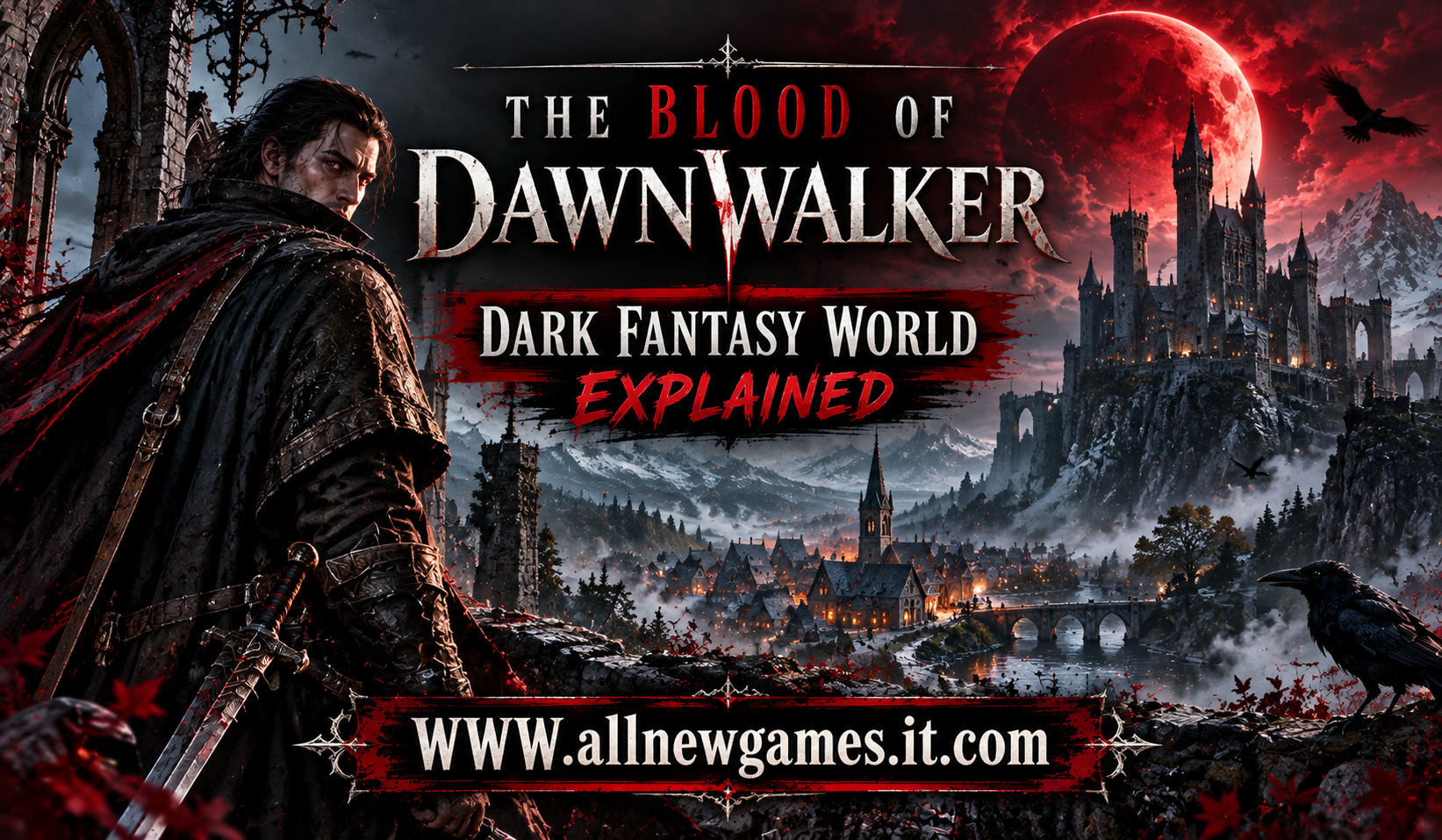
The physical environment of Sanguria is built around the Carpathian Mountains. From footage and promotional material, the region includes dense forests, mountain passes, small fortified settlements, ancient ruins, and underground locations that suggest layers of history beneath the surface.
That landscape serves a practical function in an open-world game. Mountains limit sightlines and create natural boundaries between areas. Forests close in around the player rather than opening up wide vistas. That compression is the right choice for a game about pressure and limited time. A wide, open landscape invites wandering. A dense, enclosed one pushes forward.
The environments shown so far lean toward the cold and the worn rather than the grand or the spectacular. Settlements look like places that have been trying to hold together for a long time without much help. That visual tone is consistent across the footage available, which suggests it is a deliberate art direction choice rather than a technical limitation.
Night is also a significant part of the environment design. The game’s countdown runs in nights, Cael’s vampire abilities are tied to darkness, and the world shifts when night falls in ways that change how the environment reads. A village that looks manageable during the day may look like something different once light is gone and the vampire power structure becomes visible.
Mythology and Folklore Woven Into the World
The Carpathian region is where a significant portion of Eastern European vampire mythology originates. The Blood of Dawnwalker does not use this as a trivia point. It uses it as a design foundation.
Vampire folklore in this tradition is not limited to the stylized, aristocratic figures of later Gothic fiction. The creatures in older Eastern European stories are more varied, more dangerous, and more tied to specific local fears around death, disease, and the boundary between the living and the dead. A game set in this region, in this time period, drawing on this tradition, has access to material that is less familiar to most players than the versions of vampire mythology that dominate Western popular culture.
Rebel Wolves has not detailed exactly which folklore elements appear in the game’s design. Based on what has been shown, the world does not feel like it is drawing from the Gothic vampire tradition of 19th century English literature. The tone and the visual design suggest something older and more regional, which is consistent with where and when the game is set.
That choice gives The Blood of Dawnwalker a mythology that feels specific rather than borrowed. A world with its own version of what vampires are, where they come from, and what the rules mean gives players something to learn rather than something to recognize from other media.
Key Takeaways
- Setting: Sanguria is a fictional Carpathian region in 14th century Europe, chosen for its historical and mythological fit with the game’s themes.
- Occupation: Vampires function as a governing power, not hidden monsters, controlling territory, resources, and night-time access.
- Human communities: Residents of Sanguria have developed different survival strategies under vampire rule, from cooperation to quiet resistance.
- Landscape: Dense forests, mountain terrain, and enclosed settlements create an environment that reinforces pressure rather than encouraging open wandering.
- Mythology: Eastern European vampire folklore forms the design foundation, giving the world a mythology that feels specific to its place and period.
Frequently Asked Questions
Where is Sanguria located in The Blood of Dawnwalker?
Sanguria is a fictional region set within the Carpathian Mountains of 14th century Europe, drawing on the area’s historical and folkloric context.
Are vampires hidden in the world of The Blood of Dawnwalker?
No, vampires openly control Sanguria and function as the governing authority rather than as a hidden or secretive force.
How do human communities survive in Sanguria?
Human settlements have adopted different approaches, including cooperation with vampire authority, quiet resistance, and in some cases organized opposition, each with different risks and outcomes.
Does the game draw on real vampire folklore?
The setting draws on Eastern European vampire mythology rooted in the Carpathian region, which predates and differs from the Gothic vampire tradition of later Western fiction.
How does the night cycle affect the world in The Blood of Dawnwalker?
Night is tied to Cael’s vampire abilities and the visibility of the vampire power structure, making the environment read and function differently after dark.
Conclusion
Sanguria works as a dark fantasy setting because it is built on specific choices. The 14th century Carpathian location, the vampire occupation as a governing system rather than a lurking threat, the range of human responses to that occupation, and the Eastern European folkloric tradition underneath the visual design all connect back to each other rather than sitting as separate decisions. The Blood of Dawnwalker’s world is not dark because it is gloomy. It is dark because the systems within it are genuinely bad for the people living inside them, and Cael is one of those people trying to find a way through.